Table of Contents
Best Personal Blenders 2026: Quick Comparison
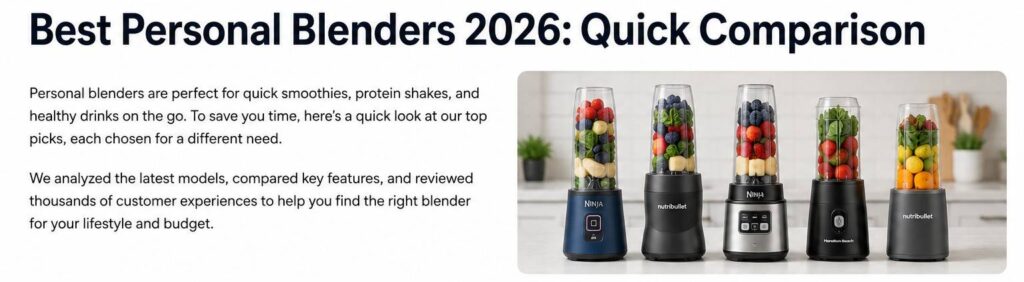
If you want a personal blender for smoothies, protein shakes, frozen drinks, or quick everyday blending, the best choice depends on how you plan to use it. Some personal blenders are built for portability, while others focus on stronger motors, larger cups, or better frozen-fruit performance.
For 2026, the five models in this comparison cover very different needs: the Ninja Blast Max is the most portable option, the NutriBullet Ultra focuses on higher power and quieter blending, the Ninja BN401 is a strong countertop pick with Auto-iQ presets, the Hamilton Beach model is the most budget-friendly choice, and the NutriBullet Pro 900 is a simple high-power option for everyday smoothies.
Here is a quick breakdown before choosing which personal blender fits your kitchen, routine, and budget.
| Personal Blender | Best For | Key Strength | Potential Drawback |
|---|---|---|---|
| Ninja Blast Max Portable Blender | Travel, office, gym, small spaces | Cordless design with a removable vessel and 3 blending programs | Not the best choice if you mainly want a plug-in countertop blender |
| NutriBullet Ultra Personal Blender | Smoothies, shakes, daily nutrition drinks | 1200W motor, titanium-coated blades, and multiple BPA-free cups | Higher price than basic personal blenders |
| Ninja BN401 Auto-iQ Personal Blender | Frozen drinks, ice, smoothies, salsa, dips | 1100-peak-watt motor and 2 Auto-iQ preset programs | Less portable than cordless models |
| Hamilton Beach Personal Blender | Budget buyers and simple smoothies | 400W motor with two 14 oz travel jars | Less power for harder frozen ingredients |
| NutriBullet Pro 900 | Simple daily smoothies and protein shakes | 900W motor with multiple cups and flip-top lids | No advanced preset programs |
Best Overall Personal Blender

The NutriBullet Ultra Personal Blender is the best overall pick for most people who want a balance of power, cup size, and everyday convenience. Its 1200W motor, titanium-coated blades, and included 32 oz and 24 oz cups make it better suited for users who blend smoothies, protein shakes, and thicker drinks regularly.
This personal blender makes the most sense if you want one machine for daily use at home instead of a basic travel-only blender. It is not the cheapest option, but it gives you more power and flexibility than entry-level models.
Best Portable Personal Blender

The Ninja Blast Max Portable Blender is the best portable personal blender in this lineup. It is cordless, designed with a removable vessel, and built for users who want to blend, twist, and take their drink with them. That makes it a better fit for offices, dorm rooms, gym bags, and small apartments.
Choose this model if portability matters more than maximum countertop power. It is useful for smoothies and simple blended drinks, but users who frequently crush ice or blend very thick frozen mixtures may prefer a stronger plug-in model.
Best Budget Personal Blender

The Hamilton Beach Personal Blender is the best budget option because it keeps the setup simple: a 400W motor, stainless steel blades, and two 14 oz travel jars. It is a practical pick for beginners, occasional smoothie drinkers, or anyone who wants a low-cost personal blender without paying for extra presets or premium features.
This is not the strongest blender in the comparison, so it is better for soft fruits, protein shakes, and simple smoothies rather than heavy frozen blends. For the price, though, it gives budget buyers a straightforward way to make single-serve drinks at home.
How We Researched the Best Personal Blenders
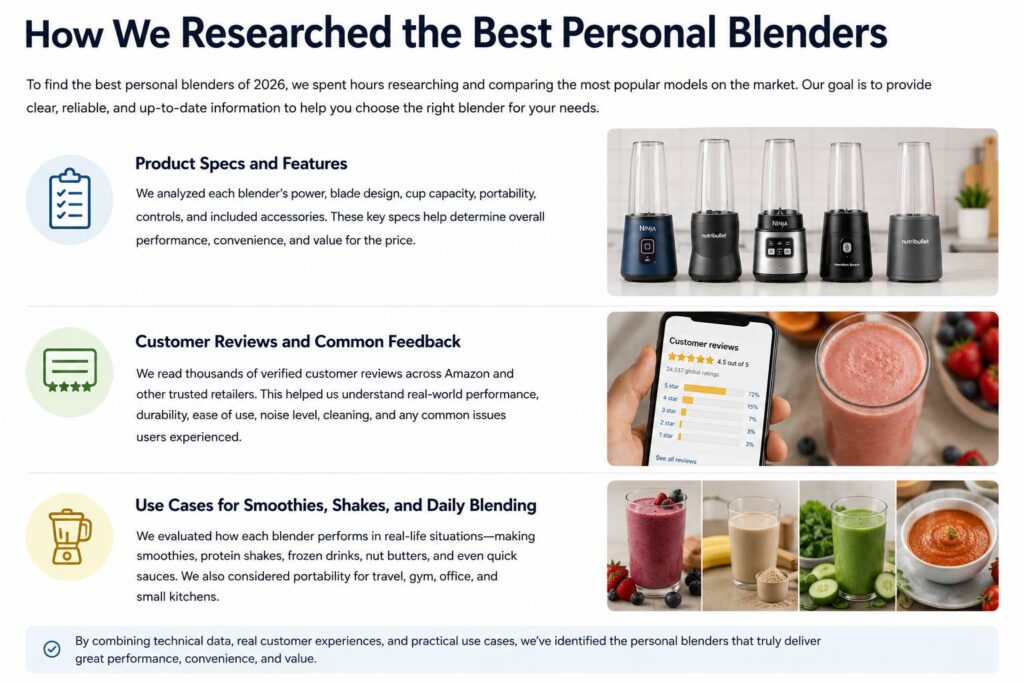
To compare the best personal blenders for 2026, we focused on the details that matter most for everyday use: motor power, cup size, portability, cleaning, included accessories, and real customer feedback. Instead of treating every model the same, we looked at how each personal blender fits different routines, from quick protein shakes to frozen fruit smoothies and small-kitchen use.
This research-based approach helps make the comparison more practical. A powerful plug-in blender may be better for frozen ingredients, while a cordless portable blender may be more useful for travel, office use, or gym routines.
Product Specs and Features
Product specs are one of the first things to check when choosing a personal blender. Motor power, blade design, cup capacity, lid type, charging or plug-in setup, and dishwasher-safe parts can all affect how useful the blender feels in daily life.
For this comparison, we looked at features such as blending power, included cups, portability, preset programs, and cleaning convenience. These details help separate a basic smoothie blender from a stronger everyday model.
Image suggestion: Add a simple spec-checklist image after this H3 showing motor power, cup size, blade design, and cleaning features.
Customer Reviews and Common Feedback
Customer reviews help show how a personal blender performs outside of the product description. We focused on common patterns in user feedback, including blending consistency, noise level, leaking issues, ease of cleaning, durability, and whether the blender handles frozen fruit well.
This matters because two blenders can look similar on paper but feel very different in real use. Repeated customer comments can reveal strengths and weaknesses that specs alone may not show.
Image suggestion: Add a review-analysis image after this H3 showing star ratings, common pros, and common complaints in a clean visual layout.
Use Cases for Smoothies, Shakes, and Daily Blending
The best personal blender depends on what you make most often. For protein shakes, a simple and easy-to-clean model may be enough. For frozen fruit smoothies, stronger power and better blade design become more important. For travel or office use, portability and leak-resistant lids matter more than maximum motor strength.
That is why this guide compares personal blenders by real use case, not just by price or brand. The goal is to help readers choose the model that fits their actual routine.
Top Personal Blenders 2026: Our Researched Picks
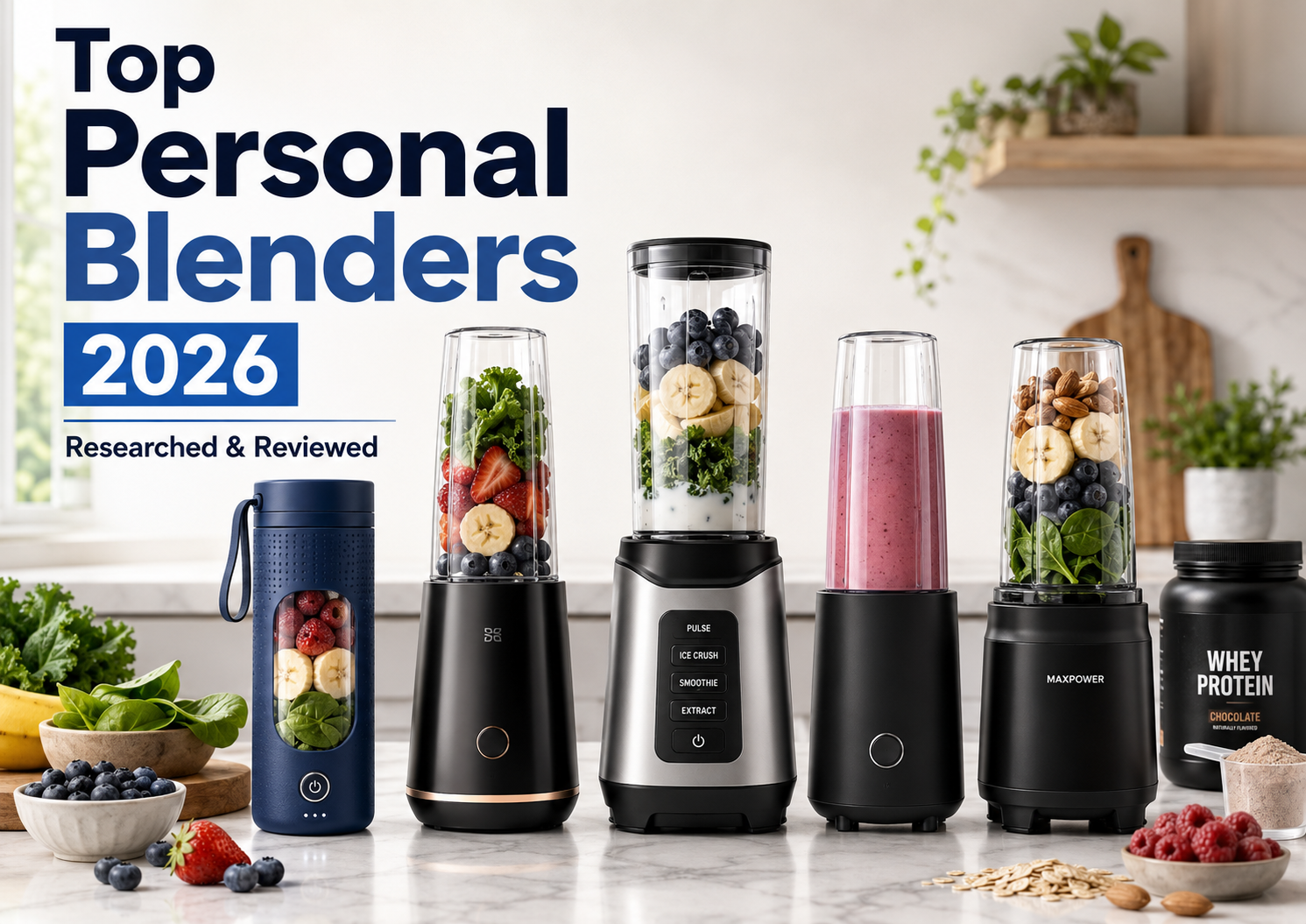
Here are our researched picks for the best personal blenders in 2026, based on product specs, features, customer feedback patterns, and everyday use cases. Each model has a different strength, so the best choice depends on whether you care most about portability, power, price, or simple daily smoothie making.
This section is designed to help readers quickly understand which personal blender fits their routine before comparing the details more closely.
Image suggestion: Add a clean comparison image directly after this H2 intro showing all five personal blenders side by side with short labels such as Best Portable, Best Overall, Best for Frozen Drinks, Best Budget, and Best Simple Power Pick.
Ninja Blast Portable Blender

The Ninja Blast Portable Blender is the best fit for people who want a cordless personal blender for travel, the office, the gym, or small spaces. Its main advantage is portability: the removable vessel design makes it easier to blend and take your drink with you without relying on a kitchen outlet.
This model makes the most sense for simple smoothies, protein shakes, and lighter frozen drinks. If you want a personal blender mainly for home use with harder frozen ingredients, a stronger plug-in model may be a better choice.
Image suggestion: Add a lifestyle image after this section showing a portable personal blender near a gym bag, office desk, or travel setup. Do not use an AI-generated image as the exact product photo; use the official product image for the product card.
NutriBullet Ultra Personal Blender

The NutriBullet Ultra Personal Blender is a strong pick for users who want more power in a compact single-serve design. Its 1200-watt motor, streamlined base, and simple blending interface make it a good option for daily smoothies, protein shakes, and thicker blends.
This personal blender is best for people who want a premium countertop option without moving up to a full-size blender. It costs more than basic models, but it offers stronger performance and a more modern design for frequent use.
Image suggestion: Add a kitchen-counter image after this section showing a premium personal blender setup with frozen fruit, greens, and smoothie cups. Use official product images if you want to show the exact NutriBullet Ultra design.
Ninja BN401 Auto-iQ Personal Blender

The Ninja BN401 Auto-iQ Personal Blender is a good choice for users who want stronger blending power and preset programs. Its 1100-peak-watt motor and Auto-iQ programs make it useful for smoothies, frozen drinks, shakes, salsa, and dips.
This model is less portable than a cordless blender, but it is better suited for people who want a reliable plug-in personal blender for regular kitchen use. It is especially worth considering if you often blend frozen fruit or want simple preset controls.
Image suggestion: Add an action-style kitchen image after this section showing frozen fruit, ice, and a smoothie cup to support the idea of stronger blending performance.
Hamilton Beach Personal Blender

The Hamilton Beach Personal Blender is the best budget-friendly option in this lineup. It keeps things simple with a compact design, travel jars, stainless steel blades, and a lower price point than most higher-power personal blenders.
This model is best for beginners, occasional smoothie drinkers, or anyone who wants an affordable personal blender for soft fruit smoothies and protein shakes. It is not the strongest option for heavy frozen ingredients, but it is practical for simple daily drinks.
Image suggestion: Add a small-kitchen image after this section showing a simple blender setup with bananas, berries, and a travel cup. This helps reinforce the budget and beginner-friendly angle.
NutriBullet Pro 900

The NutriBullet Pro 900 is a simple high-power personal blender for people who want strong everyday blending without advanced presets. Its 900-watt motor makes it a step up from basic personal blenders, especially for users who blend smoothies, greens, and slightly tougher ingredients often.
This model is best for readers who want a straightforward countertop blender with more power than entry-level options. It does not have the same modern interface as the NutriBullet Ultra or preset programs like the Ninja BN401, but it remains a practical choice for daily smoothies and protein shakes.
Best Personal Blender for Different Needs
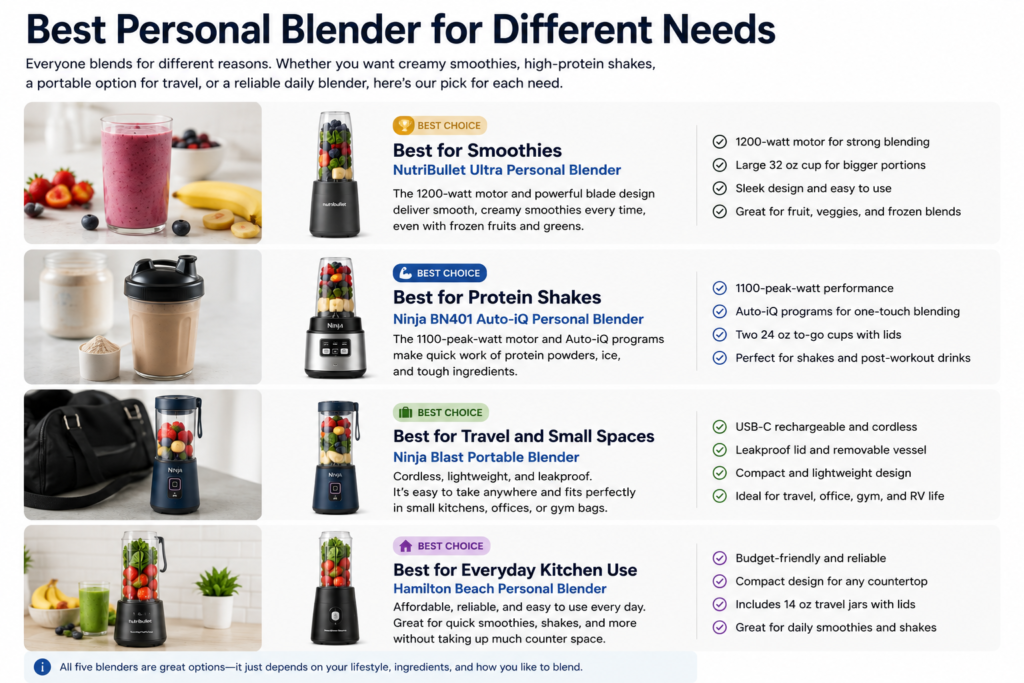
The best personal blender is not always the most powerful or the most expensive one. The right choice depends on how you plan to use it: smoothies, protein shakes, travel, small kitchens, or everyday blending at home.
For this section, we matched each personal blender to a specific use case so readers can choose based on their lifestyle instead of only comparing wattage or price.
Image suggestion: Add one comparison-style lifestyle image after this H2 intro. The image should show four use cases side by side: smoothies, protein shakes, travel/small spaces, and everyday kitchen use.
Best for Smoothies
The NutriBullet Ultra Personal Blender is the best choice for smoothies if you want strong power in a compact countertop design. Its 1200-watt motor and single-serve cup setup make it a strong fit for fruit smoothies, green smoothies, and thicker blended drinks.
It is a better match for readers who make smoothies often and want a smoother, more premium blending experience than a basic budget model. If smoothie quality is your main priority, this is the personal blender to look at first.
Image suggestion: Add a smoothie-focused kitchen image after this H3 showing frozen berries, bananas, greens, and a filled blending cup.
Best for Protein Shakes
The NutriBullet Pro 900 is a practical pick for protein shakes because it keeps the process simple: add liquid, protein powder, fruit, or greens, then twist and blend. Its 900-watt motor gives it more power than entry-level personal blenders without adding complicated controls.
This personal blender works well for people who want a quick morning shake, post-workout drink, or simple daily nutrition routine. It is not the most advanced model in the lineup, but its straightforward design makes it easy to use regularly.
Image suggestion: Add a post-workout protein shake image after this H3 showing protein powder, a shaker-style cup, banana, milk, and a compact blender setup.
Best for Travel and Small Spaces
The Ninja Blast Portable Blender is the best fit for travel, dorm rooms, offices, gyms, and small apartments. Its cordless design and removable vessel make it easier to use away from a traditional kitchen setup.
This is the right personal blender for readers who care more about convenience and portability than maximum blending power. It is best for simple smoothies, light frozen drinks, and quick blends when counter space or outlets are limited.
Image suggestion: Add a travel-friendly image after this H3 showing a portable blender beside a gym bag, laptop, or small apartment counter.
Best for Everyday Kitchen Use
The Ninja BN401 Auto-iQ Personal Blender is the best option for everyday kitchen use if you want stronger blending power and preset programs. Its 1100-peak-watt motor and Auto-iQ programs make it useful for smoothies, shakes, frozen drinks, salsa, and dips.
This personal blender is less portable than the Ninja Blast, but it is a better fit for readers who want a plug-in blender they can keep on the counter and use several times a week. It offers a good balance of power, convenience, and versatility for regular home use.
What to Look for in a Personal Blender
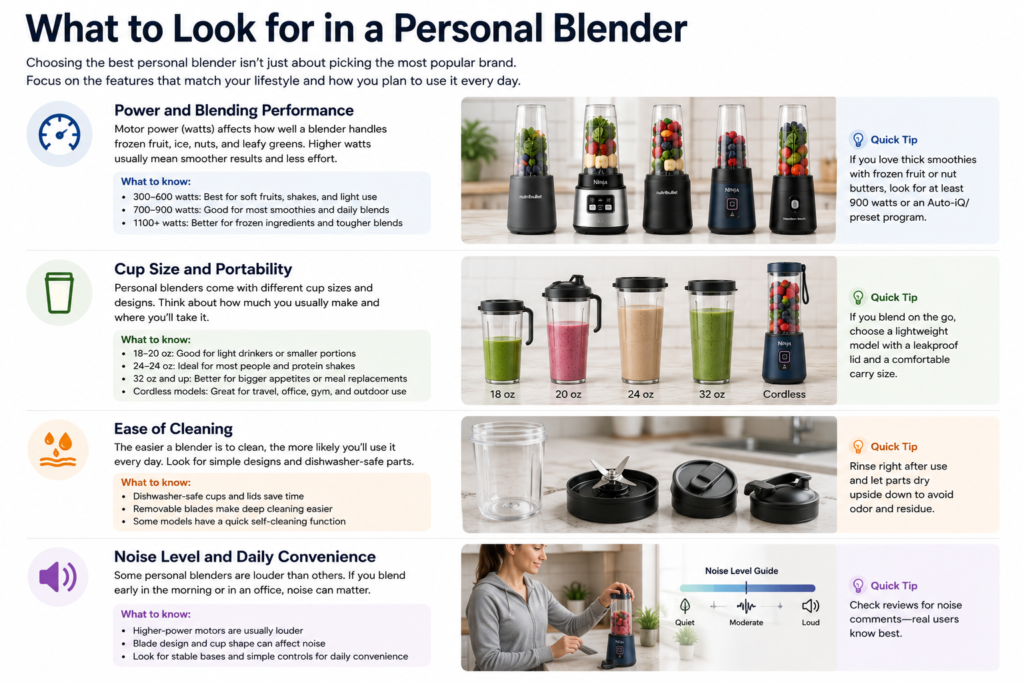
When choosing a personal blender, do not look at price alone. The best model should match what you actually blend, how often you use it, where you plan to store it, and how much cleanup you are willing to do.
For most buyers, the biggest factors are power, cup size, portability, cleaning, and daily convenience. A compact cordless blender may be better for travel, while a stronger plug-in personal blender is usually a better fit for frozen fruit, thicker smoothies, and frequent kitchen use.
Image suggestion: Add a simple buyer’s checklist image after this H2 intro. The image should show the four key buying factors: power, cup size, cleaning, and noise/convenience.
Power and Blending Performance
Power matters most if you blend frozen fruit, ice, greens, or thick smoothie bowls. A lower-powered personal blender can still work well for soft fruit, protein shakes, and simple drinks, but it may struggle with harder ingredients.
If you want smoother results, look beyond wattage and check the blade design, preset programs, and what the product is designed to handle. For example, some personal blenders are built mainly for portability, while others are designed for stronger countertop performance.
Image suggestion: Add a visual after this H3 showing soft ingredients on one side and tougher frozen ingredients on the other, with a “check motor power” reminder.
Cup Size and Portability
Cup size affects how practical a personal blender feels in daily use. Smaller cups are easier to carry and store, while larger cups are better for full smoothies, meal replacement shakes, or bigger servings.
If you plan to use your blender at the office, gym, dorm, or while traveling, portability should be a priority. Look for travel lids, leak-resistant design, cordless operation, and a cup shape that fits your bag or car cup holder.
Image suggestion: Add a portability image after this H3 showing different cup sizes beside a gym bag, laptop, and kitchen counter.
Ease of Cleaning
A personal blender is only useful if you are willing to clean it after every use. Dishwasher-safe cups and lids can save time, but you should also check whether the blade area is easy to rinse and whether ingredients get trapped around the seal.
For everyday use, simple cleaning matters as much as blending power. If cleanup feels annoying, you are less likely to use the blender regularly.
Image suggestion: Add a cleaning-focused image after this H3 showing a blender cup, lid, and blade area being rinsed under running water.
Noise Level and Daily Convenience
Noise level is easy to overlook, but it matters if you blend early in the morning, live with roommates, or use a blender in a small apartment. More powerful personal blenders may be louder, while some newer models focus on quieter blending and a smoother user experience.
Also check small convenience details such as one-touch controls, preset programs, leak-resistant lids, cord storage, and whether the cup can go from blending to drinking without transferring the smoothie into another bottle.
Personal Blender Pros and Cons
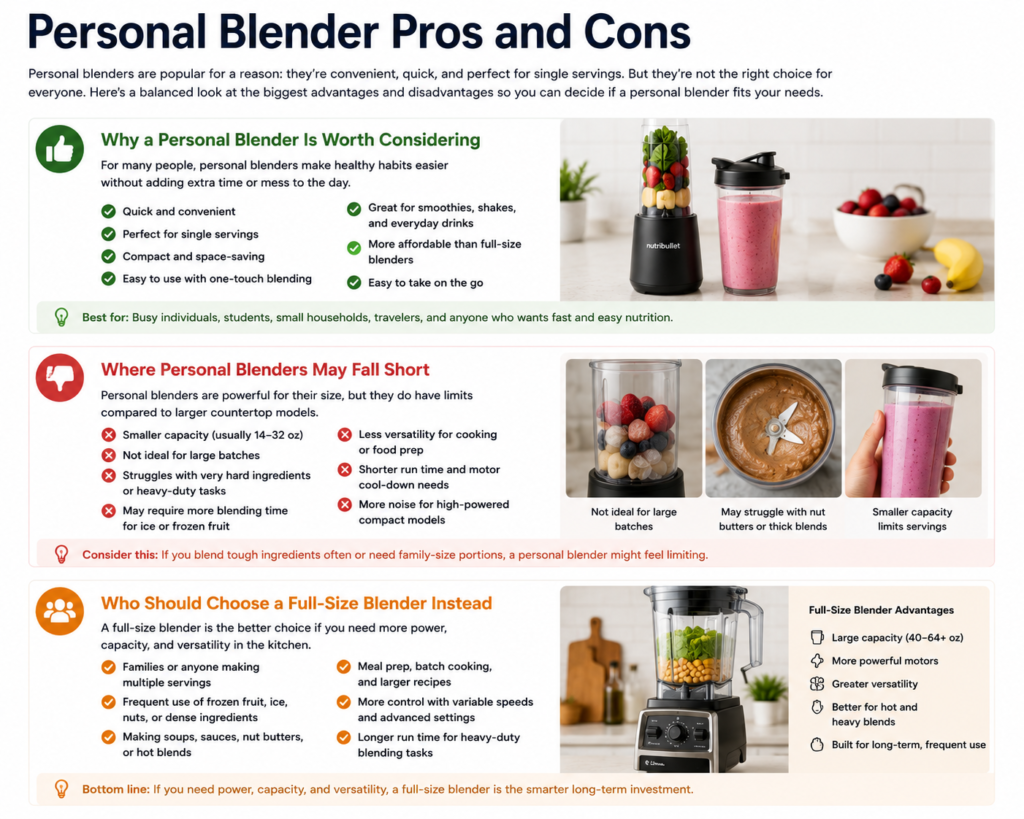
A personal blender can be a smart choice if you want quick smoothies, protein shakes, and single-serve drinks without using a large countertop blender. These compact machines are usually easier to store, faster to clean, and more convenient for daily routines.
That said, personal blenders are not the best fit for every kitchen. Before buying one, it helps to understand where they perform well and where a full-size blender may still be the better option.
Image suggestion: Add a pros-and-cons infographic after this H2 intro. The image should clearly compare convenience, size, cleaning, blending limits, and when to choose a full-size blender instead.
Why a Personal Blender Is Worth Considering
A personal blender is worth considering if you mostly make single-serve smoothies, protein shakes, or quick drinks. It takes up less counter space than a full-size blender and is usually easier to use for simple daily blending.
For busy mornings, small kitchens, dorm rooms, offices, and post-workout routines, a personal blender can make healthy drinks feel more convenient. Many models also come with travel cups or drinking lids, so you can blend and take your drink with you.
Image suggestion: Add a lifestyle image after this H3 showing a compact personal blender beside a smoothie cup, fruit, and a small kitchen counter.
Where Personal Blenders May Fall Short
The biggest limitation of a personal blender is capacity. Most models are designed for one serving, so they are not ideal for families, large batches, or meal prep. Some models may also struggle with very hard frozen ingredients, thick nut butters, or dense mixtures.
Another downside is versatility. A personal blender is great for drinks, but it may not replace a larger blender for soups, sauces, frozen desserts, or heavy-duty kitchen tasks. Higher-power compact models can also be noisy during blending.
Image suggestion: Add a limitation-focused image after this H3 showing small cup capacity, frozen ingredients, and a comparison between single-serve and family-size portions.
Who Should Choose a Full-Size Blender Instead
A full-size blender is the better choice if you regularly make large batches, cook for multiple people, or blend tough ingredients often. It usually offers more capacity, stronger motors, longer run time, and more control over speed settings.
Choose a full-size blender instead of a personal blender if you want to make soups, sauces, nut butters, frozen desserts, or family-size smoothies. A personal blender is more convenient, but a full-size blender is more flexible for serious kitchen use.
Final Verdict
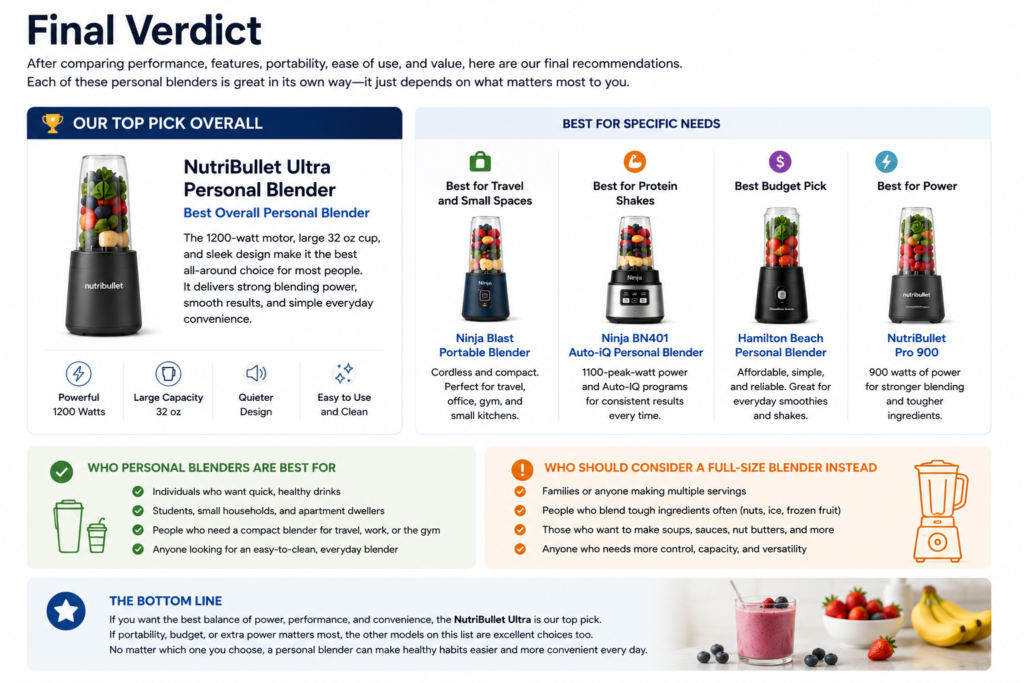
If you want the best personal blender for most people, the NutriBullet Ultra Personal Blender is the strongest all-around pick. It offers a good balance of power, cup size, modern design, and everyday smoothie convenience, making it a smart choice for users who blend often and want something more capable than a basic budget model.
For portability, the Ninja Blast Portable Blender is the better choice. Its cordless design and removable vessel make it a better fit for travel, offices, gyms, dorm rooms, and small spaces. It is not the best pick for users who only want maximum countertop power, but it makes the most sense for grab-and-go blending.
For stronger plug-in performance, the Ninja BN401 Auto-iQ Personal Blender is worth considering. It is a better match for people who want preset programs and more power for smoothies, frozen drinks, shakes, salsa, and dips.
For budget buyers, the Hamilton Beach Personal Blender is the simplest low-cost option. It is best for soft fruit smoothies, protein shakes, and occasional use, but it is not the best choice for tougher frozen ingredients or heavy daily blending.
The NutriBullet Pro 900 sits in the middle as a simple, powerful everyday option. It does not have the newer interface of the NutriBullet Ultra or the Auto-iQ presets of the Ninja BN401, but it is still a practical choice for people who want straightforward smoothie and shake blending.
Bottom line: choose the NutriBullet Ultra if you want the best overall personal blender, the Ninja Blast if portability matters most, the Ninja BN401 if you want stronger plug-in blending with presets, the Hamilton Beach if you want the lowest-cost option, and the NutriBullet Pro 900 if you want simple daily power without extra features.
Image suggestion: Add one final recommendation graphic directly after this section. The image should summarize the five picks by buyer type: Best Overall, Best Portable, Best Plug-In Power, Best Budget, and Best Simple Daily Pick.
Frequently Asked Questions
Here are quick answers to the most common questions people ask before buying a personal blender. These answers can help you understand what a personal blender can handle, where it may struggle, and how to keep it working well.
Image suggestion: Add one FAQ-style infographic after this H2 intro. The image should summarize frozen fruit, ice, lifespan, and cleaning in a simple question-and-answer layout.
Are personal blenders good for frozen fruit?
Yes, many personal blenders can handle frozen fruit, especially models with stronger motors and sharp blade designs. For smoother results, use smaller frozen fruit pieces, add enough liquid, and avoid overfilling the cup.
If you blend frozen fruit often, choose a higher-powered personal blender instead of a basic low-watt model. This helps reduce chunks and gives you a smoother texture.
Can a personal blender crush ice?
Some personal blenders can crush ice, but performance depends on motor power, blade design, and the size of the ice cubes. Stronger plug-in models are usually better for ice than compact cordless or budget personal blenders.
For best results, use small ice cubes and blend with liquid. Large ice cubes or dry ice blending can be harder on the motor and blades.
How long do personal blenders usually last?
A personal blender can usually last several years with proper use and cleaning, but the exact lifespan depends on build quality, how often you use it, and what ingredients you blend.
To make your blender last longer, avoid overfilling the cup, do not force it through ingredients it is not designed to handle, and clean the blades, lid, and cup after each use.
Are personal blenders easy to clean?
Yes, most personal blenders are easy to clean because they use small cups and simple lids. Many models include dishwasher-safe cups or lids, which makes cleanup faster after smoothies and protein shakes.
For daily use, rinse the cup and blade area right after blending. This prevents dried smoothie residue, odors, and buildup around the seal.