Table of Contents
Quick Comparison Table
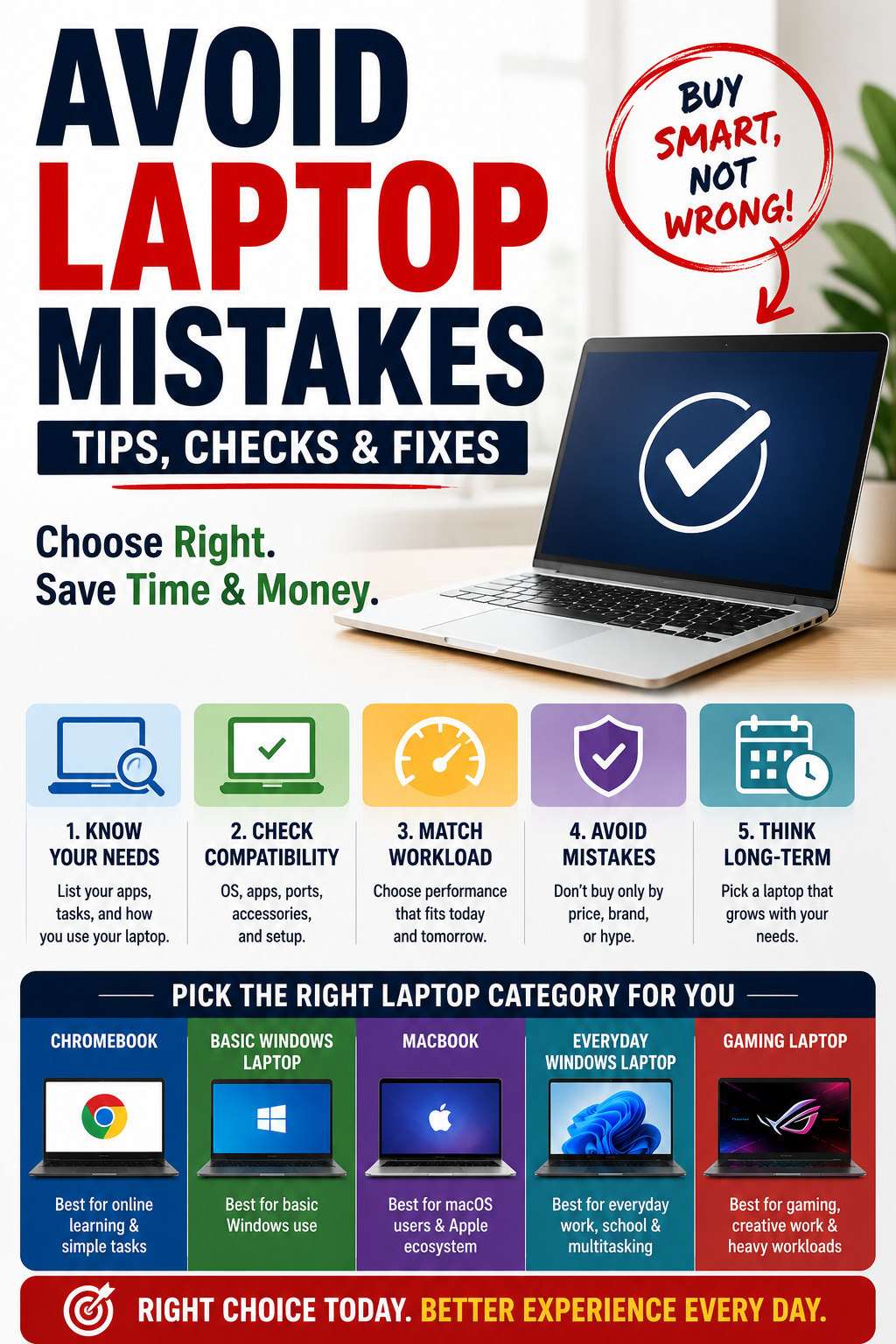
Common laptop buying mistakes often start before the laptop is even purchased. Many laptop problems are not caused by a bad product. They happen because the buyer chooses the wrong operating system, underestimates the workload, ignores compatibility, or buys a laptop category that does not match daily use.
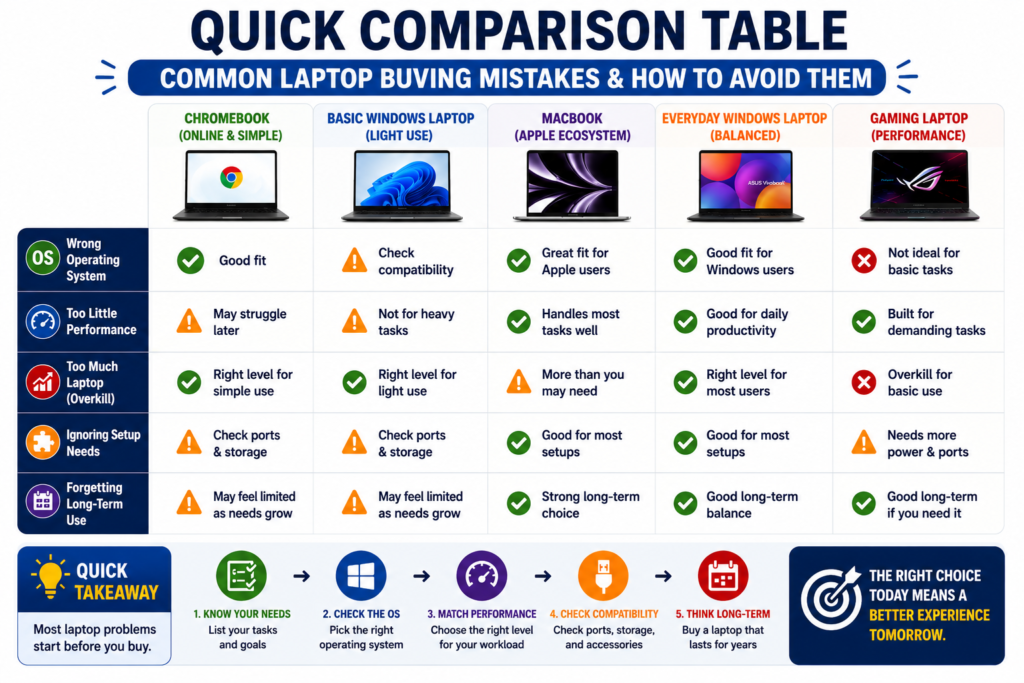
This quick comparison table helps you avoid the most common pre-purchase mistakes. The goal is not to say that any specific laptop is flawed. The goal is to help you match the right laptop type to your apps, workload, operating system, and long-term needs.
| Buying Mistake | What Can Go Wrong | Example Category from This Series | Better Way to Decide |
|---|---|---|---|
| Choosing the wrong operating system | You may not be able to use the apps, school tools, or work software you need every week. | Lenovo IdeaPad Chromebook / Lenovo IdeaPad Slim 3 related Amazon listing, Apple 2026 MacBook 15-inch Laptop related Amazon listing, or Windows laptop options | Check whether ChromeOS, Windows, or macOS fits your required apps before choosing the laptop. |
| Buying too little performance | A basic laptop may feel frustrating if you later need gaming, editing, heavy multitasking, or demanding software. | Lenovo IdeaPad Chromebook / Lenovo IdeaPad Slim 3 related Amazon listing, or HP Stream BrightView N4120 Graphics related Amazon listing | Choose a lighter laptop only if your workload is simple, online, and predictable. |
| Buying too much laptop | You may pay for performance you do not actually use if your daily tasks are simple. | ASUS ROG Strix Gaming Laptop related Amazon listing | Choose a gaming laptop only if gaming, streaming, creative work, or heavier workloads are real priorities. |
| Ignoring everyday productivity needs | A laptop may technically work, but still feel limiting for documents, multitasking, video calls, and daily workflow. | ASUS Vivobook 14 / i3-1115G4 Graphics related Amazon listing, HP Stream BrightView N4120 Graphics related Amazon listing, or Apple 2026 MacBook 15-inch Laptop related Amazon listing | Think about your normal workday, not just the lowest price or the most familiar brand. |
| Forgetting long-term use | A laptop that fits today may feel limited if your school, work, apps, or creative needs grow later. | All laptop categories in this series | Choose a laptop category that still makes sense for your next few years of use, not only your current task list. |
A Chromebook-style laptop such as the Lenovo IdeaPad Chromebook / Lenovo IdeaPad Slim 3 related Amazon listing can make sense for online classes, browsing, Google Docs, email, and simple daily tasks. The mistake is choosing this category if you already know you need Windows-only software or heavier local apps.
A basic Windows laptop such as the HP Stream BrightView N4120 Graphics related Amazon listing may fit light Windows tasks, documents, browsing, and video calls. The mistake is expecting a basic laptop category to handle gaming, editing, heavy multitasking, or demanding software without frustration.
A MacBook such as the Apple 2026 MacBook 15-inch Laptop related Amazon listing can be a strong fit for users who prefer macOS and Apple ecosystem workflows. The mistake is choosing it only because it feels premium, without checking whether your school, work, or apps require Windows.
A gaming laptop such as the ASUS ROG Strix Gaming Laptop related Amazon listing is the performance-focused option in this series. The mistake is buying a gaming laptop for simple browsing, documents, and video calls if you do not actually need performance headroom.
An everyday Windows laptop such as the ASUS Vivobook 14 / i3-1115G4 Graphics related Amazon listing can be a more balanced category for general productivity. The mistake is ignoring whether your real workflow needs a simple online laptop, a MacBook, or a heavier gaming laptop instead.
Quick takeaway: the most common laptop problems often come from choosing the wrong category. Start with your operating system, required apps, workload, daily routine, and long-term needs before comparing laptop names.
Common Laptop Problems That Start Before You Buy
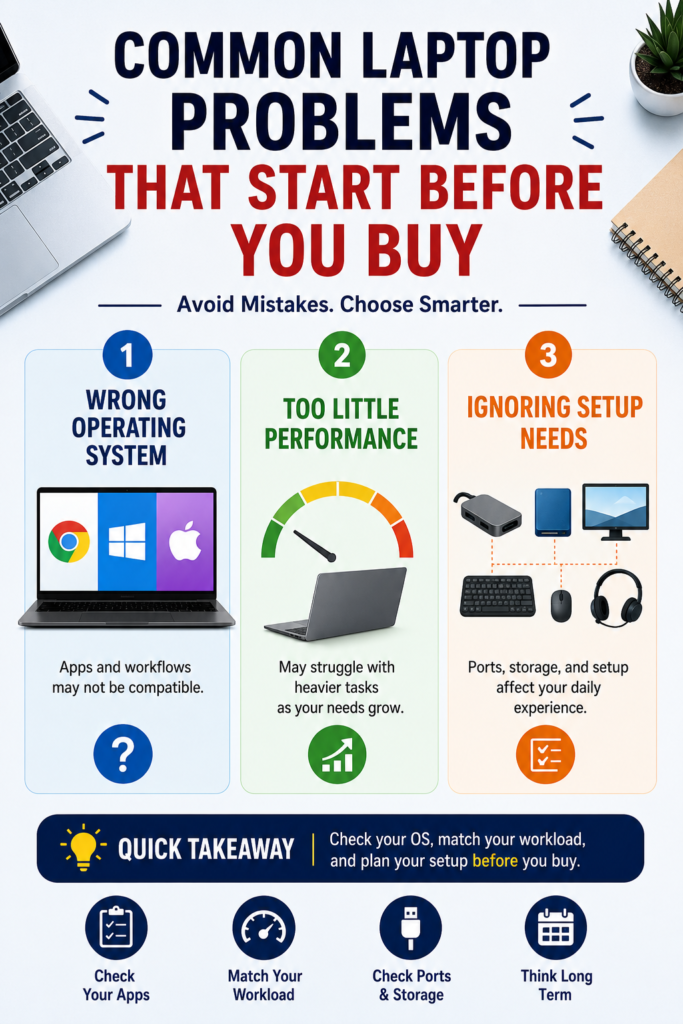
Many common laptop buying mistakes happen before the laptop is even delivered. A laptop can seem like a good deal, look powerful enough, or come from a familiar brand, but still become frustrating if it does not match your operating system, software, workload, ports, storage needs, or daily setup.
This section is not about saying that one specific laptop is defective. It is about helping you avoid the kind of mismatch that creates problems later. Before choosing between a Chromebook, basic Windows laptop, MacBook, everyday Windows laptop, or gaming laptop, you need to know what could go wrong if the category does not fit your real use case.
Choosing the Wrong Operating System
One of the biggest laptop problems starts with choosing the wrong operating system. ChromeOS, Windows, and macOS are not just different interfaces. They support different workflows, apps, file habits, and software expectations.
A Chromebook-style laptop such as the Lenovo IdeaPad Chromebook / Lenovo IdeaPad Slim 3 related Amazon listing can make sense for web browsing, Google Docs, email, online learning, video calls, and simple cloud-based tasks. The problem starts if you choose this category while needing Windows-only software, offline desktop apps, or heavier local programs.
A basic Windows laptop such as the HP Stream BrightView N4120 Graphics related Amazon listing may be better if you need simple Windows use. However, Windows compatibility does not automatically mean the laptop is right for every workload. If your apps are demanding, you still need to think about performance and long-term fit.
A MacBook such as the Apple 2026 MacBook 15-inch Laptop related Amazon listing can be a strong choice for users who prefer macOS and Apple ecosystem workflows. The mistake is choosing macOS only because it feels premium, without checking whether your school, work, or software depends on Windows.
| Operating System Mistake | What Can Go Wrong | Better Check Before Buying |
|---|---|---|
| Choosing ChromeOS without checking apps | You may later discover that required Windows software does not fit your workflow. | List your required school, work, and desktop apps before choosing a Chromebook. |
| Choosing Windows only because it feels familiar | You may still choose a laptop category that is too basic for your workload. | Check both operating system compatibility and workload needs. |
| Choosing macOS only because it feels premium | You may run into software mismatch if your daily tools require Windows. | Confirm that your apps, files, and work habits fit macOS. |
Buying Too Little Performance for Your Workload
Another common mistake is buying a laptop that fits today’s light tasks but does not fit tomorrow’s workload. A basic laptop can be fine for browsing, documents, video calls, and simple schoolwork, but it may feel limiting if your needs grow into gaming, editing, streaming, creative work, heavy multitasking, or demanding apps.
This does not mean every buyer needs a gaming laptop. It means the laptop category should match your realistic workload. The ASUS ROG Strix Gaming Laptop related Amazon listing is the performance-focused option in this series, but it makes sense only if you actually need performance headroom.
For lighter use, the Lenovo IdeaPad Chromebook / Lenovo IdeaPad Slim 3 related Amazon listing or the HP Stream BrightView N4120 Graphics related Amazon listing may be easier to justify. For balanced daily Windows productivity, the ASUS Vivobook 14 / i3-1115G4 Graphics related Amazon listing may be the more practical category. The mistake is expecting a simple laptop category to handle tasks it was not chosen for.
Before buying, think about how your workload may change. A student may start with online classes but later need specific apps. A home user may later need more multitasking. A casual user may begin editing videos, streaming, or gaming. If your future workload may grow, choose a laptop category with enough room for that change.
| Performance Mistake | What Can Go Wrong | Better Way to Decide |
|---|---|---|
| Buying for only today’s light tasks | The laptop may feel limiting if your school, work, or creative needs grow. | Think about your next few years, not only your current task list. |
| Expecting a basic laptop to handle heavy work | Gaming, editing, streaming, or heavy multitasking may become frustrating. | Choose a stronger laptop category if heavier work is part of your plan. |
| Buying a gaming laptop without needing performance | You may pay for capability that does not improve your simple daily routine. | Choose performance only when your workload actually needs it. |
Ignoring Ports, Storage, and Everyday Setup Needs
Some laptop problems are not about raw performance. They come from everyday setup details that buyers forget to check. Ports, storage habits, accessories, external displays, file management, and desk setup can affect how useful the laptop feels after purchase.
For example, a laptop may be fine for basic tasks but still feel inconvenient if it does not have the connections you need. You may need to connect a mouse, external monitor, USB-C hub, storage device, charger, headset, or other accessories. If you ignore your setup, the laptop may feel incomplete even if the category is otherwise reasonable.
Storage habits also matter. Some users rely mostly on cloud storage, while others save documents, photos, videos, projects, and downloads locally. Without checking your actual storage needs, you may choose a laptop that feels restrictive later.
Everyday comfort matters too. If you work at a desk, screen size, keyboard comfort, mouse support, external monitor support, and accessory compatibility may matter more than you expect. If you carry your laptop often, protection, case fit, portability, and charging setup become more important.
| Setup Mistake | What Can Go Wrong | Better Check Before Buying |
|---|---|---|
| Ignoring ports | You may need extra adapters or hubs for your daily accessories. | Check what devices you connect every week. |
| Ignoring storage habits | You may feel limited if you save many files, photos, videos, or projects locally. | Decide whether you rely on cloud storage or local storage. |
| Ignoring desk setup | The laptop may feel uncomfortable for long work sessions. | Think about external monitor, mouse, keyboard, hub, and workspace needs. |
| Ignoring carrying needs | The laptop may not fit your school, commute, travel, or daily movement habits. | Consider how often you carry it and what accessories you need with it. |
The safest way to avoid these issues is to make a simple checklist before buying: required apps, operating system, workload, ports, storage, accessories, desk setup, and long-term use. If the laptop category does not fit these basics, it may become a problem even if the product itself looks appealing.
Quick takeaway: many laptop problems start before purchase. Avoid choosing the wrong operating system, buying too little performance, or ignoring ports, storage, and everyday setup needs. A better laptop choice starts with matching the category to your real workflow.
Laptop Buying Mistakes by User Type
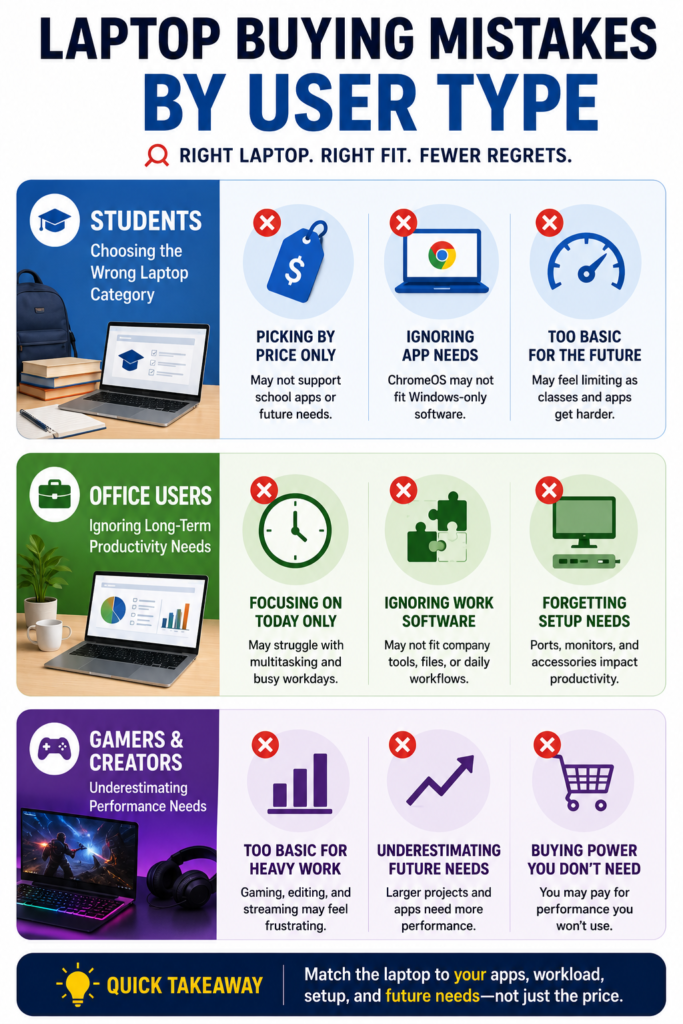
Common laptop buying mistakes often look different depending on the user. A student, office worker, gamer, creator, and casual home user may all buy the wrong laptop for different reasons. The problem is usually not that the laptop category is bad. The problem is that the laptop does not match the user’s real apps, workload, daily routine, or long-term needs.
Instead of asking which laptop is best for everyone, it is safer to ask which laptop type fits each user type. Students should think about school platforms and required apps. Office users should think about daily productivity and long-term workflow. Gamers and creators should think about performance needs before choosing a basic laptop.
Students Choosing the Wrong Laptop Category
Students often make the mistake of choosing a laptop only by price, brand, or appearance. A laptop may look affordable and simple, but it can become frustrating if it does not support the school apps, learning platforms, file tools, or video call setup the student needs every week.
A Chromebook-style laptop such as the Lenovo IdeaPad Chromebook / Lenovo IdeaPad Slim 3 related Amazon listing can make sense for students who mostly use online classes, Google Docs, Gmail, web apps, video calls, and browser-based assignments. The mistake is choosing a Chromebook if the school requires Windows-only software or offline desktop apps.
A basic Windows laptop such as the HP Stream BrightView N4120 Graphics related Amazon listing may be a better fit if the student needs a Windows environment for simple documents, browsing, online learning, and light school tasks. However, it should still be matched to realistic workload needs. If the student needs heavier multitasking, editing, or demanding software, a basic laptop category may feel limited.
| Student Mistake | What Can Go Wrong | Better Way to Decide |
|---|---|---|
| Choosing only by low price | The laptop may not support required school apps or future class needs. | Check school software and platform requirements first. |
| Choosing ChromeOS without checking app needs | Windows-only tools may not fit the student’s workflow. | Choose a Chromebook only if the work is mostly online and browser-based. |
| Choosing a basic laptop for growing workloads | The laptop may feel limiting if the student later needs more demanding apps. | Think about school needs over the next few years, not only this semester. |
The better student buying habit is to list the apps and platforms used every week before choosing the laptop type. If the work is mostly online, a Chromebook category may be enough. If the school requires Windows software, a Windows laptop category is safer. If the student already uses Apple devices and needs macOS workflows, a MacBook may be worth considering.
Office Users Ignoring Long-Term Productivity Needs
Office users often make the mistake of buying a laptop that works for basic tasks today but does not support a comfortable daily workflow over time. Documents, spreadsheets, email, video meetings, browser tabs, cloud tools, external monitors, and accessories can all affect how useful a laptop feels during long work sessions.
The ASUS Vivobook 14 / i3-1115G4 Graphics related Amazon listing fits the everyday Windows laptop direction in this series. It may be a more practical category for users who want a traditional Windows laptop for school, work, browsing, documents, and general productivity.
The Apple 2026 MacBook 15-inch Laptop related Amazon listing can make sense for office users who prefer macOS and already use Apple ecosystem tools. However, the mistake is choosing a MacBook only because it feels premium, without checking whether your work apps, company tools, files, and software requirements fit macOS.
A basic Windows laptop such as the HP Stream BrightView N4120 Graphics related Amazon listing may be enough for light office use, but office users should think carefully about long-term productivity. If your work involves more multitasking, more apps, more video meetings, or more desk accessories, a very basic category may become less comfortable over time.
| Office User Mistake | What Can Go Wrong | Better Way to Decide |
|---|---|---|
| Choosing only for basic tasks | The laptop may feel limited during multitasking, meetings, and longer work sessions. | Think about your full workday, not only email and documents. |
| Ignoring work software requirements | The laptop may not fit company tools, file workflows, or required apps. | Check whether Windows or macOS fits your work environment. |
| Forgetting desk setup needs | You may later need hubs, monitors, keyboards, mice, or extra accessories to work comfortably. | Think about ports, external display needs, and daily accessories before buying. |
The better office buying habit is to think in terms of productivity fit. A laptop should support your apps, meetings, documents, browser tabs, accessories, and long-term workflow. The right category is not always the most powerful one, but it should not slow down the way you work every day.
Gamers and Creators Underestimating Performance Needs
Gamers and creators often make the opposite mistake from casual users. Instead of buying too much laptop, they sometimes buy too little laptop for the workload they actually want to run. Gaming, streaming, editing, content creation, creative software, and heavier multitasking can require more performance headroom than basic browsing or documents.
The ASUS ROG Strix Gaming Laptop related Amazon listing is the performance-focused option in this series. It makes more sense for users who actually need a gaming laptop category for games, streaming, creative work, or heavier workloads.
The mistake is choosing a Chromebook, basic Windows laptop, or light everyday laptop if your real goal is gaming, editing, streaming, or demanding creative work. A lighter laptop category can be practical for simple tasks, but it may become frustrating if you expect it to handle workloads it was not chosen for.
At the same time, not every creator or gamer needs to buy the most powerful-looking laptop. The better question is whether your actual apps, games, editing tasks, streaming setup, or creative workflow require a performance-focused category. If they do, a gaming laptop category may be worth considering. If they do not, an everyday laptop may be enough.
| Gamer / Creator Mistake | What Can Go Wrong | Better Way to Decide |
|---|---|---|
| Choosing a basic laptop for heavy work | Gaming, editing, streaming, or creative apps may feel frustrating. | Choose a stronger category if performance-heavy work is part of your plan. |
| Underestimating future creative needs | The laptop may feel limiting as projects, files, apps, or multitasking needs grow. | Think about future workload, not only your current beginner setup. |
| Buying performance only for appearance | You may choose more laptop than you need if your daily work is simple. | Match the laptop category to real software and workload demands. |
The better buying habit for gamers and creators is to define the workload clearly. If you need gaming, streaming, editing, creative software, or heavier multitasking, do not treat a basic laptop as a performance machine. If your needs are still light, avoid buying power only because the laptop looks stronger.
Quick takeaway: students should check school apps first, office users should think about long-term productivity, and gamers or creators should match the laptop category to real performance needs. The right laptop depends on the user type, not just the product name.
Product Category Problems to Watch For
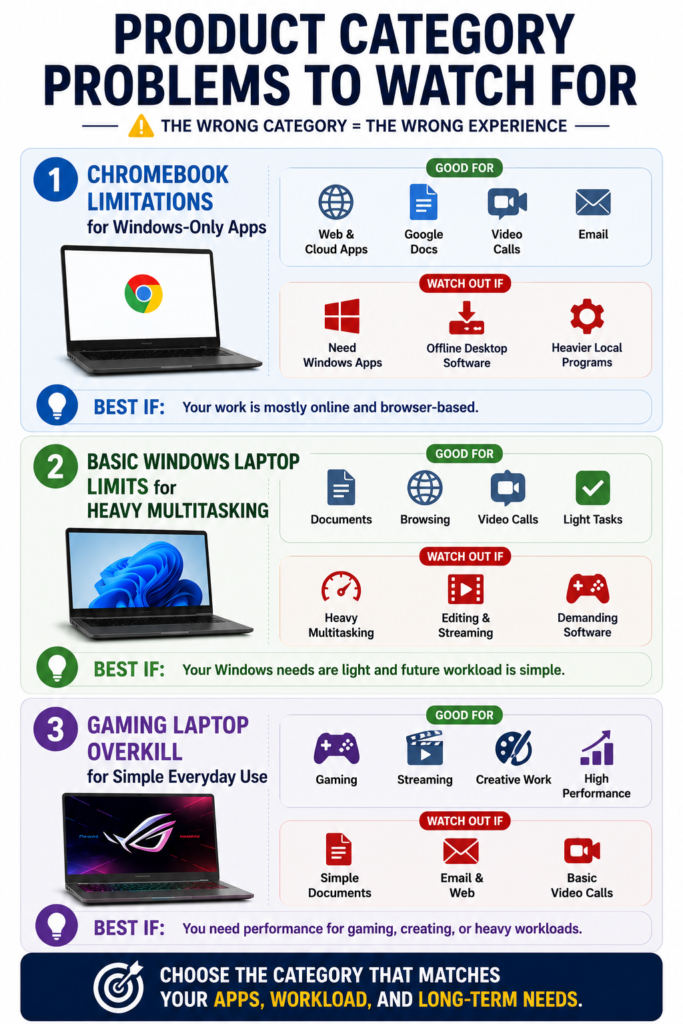
Some common laptop buying mistakes happen because buyers choose the wrong product category. A Chromebook, basic Windows laptop, MacBook, everyday Windows laptop, and gaming laptop are not designed for the same type of user. The problem usually starts when a buyer expects one category to do the job of another.
This does not mean one category is always better or worse. A Chromebook can be practical for online work. A basic Windows laptop can make sense for simple productivity. A gaming laptop can be useful for heavier workloads. The mistake is choosing a category without checking apps, workload, operating system, and long-term use.
Chromebook Limitations for Windows-Only Apps
A Chromebook-style laptop can be a good fit for users who mostly work online. In this series, the Lenovo IdeaPad Chromebook / Lenovo IdeaPad Slim 3 related Amazon listing fits the Chromebook category. It makes sense for browser-based tasks such as web browsing, Google Docs, email, online learning, video calls, streaming, and simple daily use.
The problem starts when a buyer chooses a Chromebook while needing Windows-only apps, offline desktop software, or school and work tools that require a Windows environment. ChromeOS can be simple and useful, but it should not be treated as a direct replacement for every Windows laptop workflow.
Before choosing a Chromebook, list the apps you use every week. If your work is mostly web-based, a Chromebook may be enough. If you need specific Windows software, a Chromebook may create compatibility problems later.
| Chromebook Category | Good Fit For | Watch Out If |
|---|---|---|
| Lenovo IdeaPad Chromebook / Lenovo IdeaPad Slim 3 related Amazon listing | Online learning, Google Docs, email, web apps, video calls, and light daily tasks | You need Windows-only apps, offline desktop programs, or heavier local software. |
Basic Windows Laptop Limits for Heavy Multitasking
A basic Windows laptop can be useful if you need a familiar Windows environment for simple tasks. In this series, the HP Stream BrightView N4120 Graphics related Amazon listing fits the basic Windows laptop category. It may make sense for documents, web browsing, video calls, light home use, and simple productivity.
The problem starts when a buyer expects a basic Windows laptop to handle heavier work. Windows compatibility does not automatically mean the laptop is right for gaming, editing, streaming, heavy multitasking, or demanding software. The operating system may fit, but the laptop category may still be too light for the workload.
If your work is likely to grow, think carefully before choosing a basic laptop category. Students may later need more apps. Office users may need more multitasking. Home users may start doing creative work. If your future use may become heavier, an everyday Windows laptop category such as the ASUS Vivobook 14 / i3-1115G4 Graphics related Amazon listing may be more practical than staying with the most basic category.
| Basic Windows Category | Good Fit For | Watch Out If |
|---|---|---|
| HP Stream BrightView N4120 Graphics related Amazon listing | Basic Windows use, documents, browsing, video calls, and light productivity | You expect gaming, editing, heavy multitasking, or demanding software. |
| ASUS Vivobook 14 / i3-1115G4 Graphics related Amazon listing | Everyday Windows productivity, school, office work, browsing, and general tasks | You specifically need macOS, gaming-level performance, or a very simple Chromebook-style setup. |
Gaming Laptop Overkill for Simple Everyday Use
A gaming laptop is built for a different kind of buyer. In this series, the ASUS ROG Strix Gaming Laptop related Amazon listing represents the performance-focused category. It makes sense for gaming, streaming, creative tasks, heavier multitasking, or users who need stronger performance headroom.
The problem starts when a buyer chooses a gaming laptop only because it looks powerful, but their daily tasks are simple. If you mostly browse the web, write documents, attend video calls, check email, and use basic apps, a gaming laptop may be more than you need.
This does not mean a gaming laptop is a bad choice. It can be the right category if your workload actually needs it. The mistake is buying performance without a real performance need. A simpler laptop category may be easier to justify if your work is light and predictable.
| Gaming Laptop Category | Good Fit For | Watch Out If |
|---|---|---|
| ASUS ROG Strix Gaming Laptop related Amazon listing | Gaming, streaming, creative work, heavier workloads, and performance-focused users | You only need browsing, documents, video calls, email, and simple daily productivity. |
The safest way to avoid category problems is to match the laptop type to your actual routine. Choose a Chromebook if your work is mostly online. Choose a basic Windows laptop if your Windows needs are light. Choose an everyday Windows laptop if you want broader daily productivity. Choose a MacBook if your workflow fits macOS and Apple ecosystem tools. Choose a gaming laptop only when performance-heavy work is a real priority.
Quick takeaway: most product category problems come from expecting one laptop type to do another laptop type’s job. Choose the category by apps, workload, operating system, and long-term fit — not just by price, brand, or appearance.
Practical Tips to Avoid Buying the Wrong Laptop
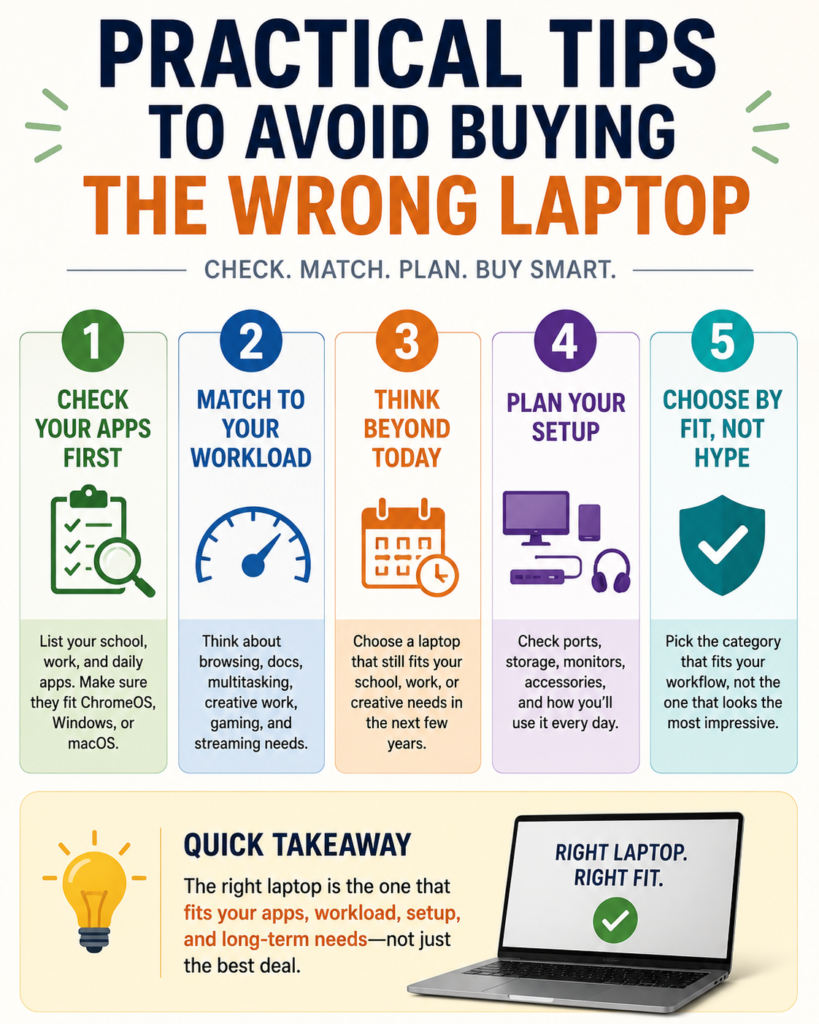
The best way to avoid common laptop buying mistakes is to slow down before comparing product names. A laptop should match your operating system, required apps, workload, setup needs, and long-term plans. If you skip those checks, even a good laptop category can become the wrong choice for your daily routine.
Start by listing what you actually do every week. Do you use browser-based tools, Google Docs, Windows apps, Apple ecosystem features, video meetings, creative software, gaming platforms, or external accessories? Your answer should guide the laptop category before brand, appearance, or price direction.
| Buying Tip | Why It Matters | Better Buying Habit |
|---|---|---|
| Check required apps first | The wrong operating system can create software problems later. | List your school, work, and daily apps before choosing ChromeOS, Windows, or macOS. |
| Match the laptop to your workload | A basic laptop can feel limited if your tasks become heavier. | Think about browsing, documents, multitasking, gaming, streaming, editing, and creative work. |
| Avoid buying only by category hype | A MacBook or gaming laptop is not automatically the right choice for every buyer. | Choose the category that fits your workflow, not the one that looks most impressive. |
| Think about your setup | Ports, storage, accessories, monitors, and carrying needs affect daily comfort. | Check what devices, files, and accessories you use every week. |
| Plan for the next few years | A laptop that fits today may feel restrictive if your needs grow. | Choose a category that still makes sense for school, work, or creative needs later. |
If your work is mostly online, a Chromebook-style laptop such as the Lenovo IdeaPad Chromebook / Lenovo IdeaPad Slim 3 related Amazon listing may be enough. But before choosing it, confirm that you do not need Windows-only apps or offline desktop software.
If you need simple Windows use, the HP Stream BrightView N4120 Graphics related Amazon listing may fit light documents, browsing, video calls, and basic productivity. The key is to avoid expecting a basic Windows laptop category to handle heavy multitasking, gaming, editing, or demanding software.
If you prefer macOS and already use Apple devices, the Apple 2026 MacBook 15-inch Laptop related Amazon listing may be the better category to consider. The mistake to avoid is choosing it only because it feels premium, without checking whether your required apps and work tools fit macOS.
If you want a traditional everyday Windows laptop, the ASUS Vivobook 14 / i3-1115G4 Graphics related Amazon listing may be a more balanced direction for school, work, browsing, documents, and general productivity. It makes more sense when your needs are broader than basic use but do not clearly require a gaming laptop.
If you need gaming, streaming, creative work, or heavier workloads, the ASUS ROG Strix Gaming Laptop related Amazon listing is the performance-focused category in this series. The mistake is choosing a gaming laptop only because it looks powerful when your daily tasks are simple.
A simple decision order can prevent many buying mistakes: choose the operating system first, check your required apps, match your workload, think about your setup, then consider long-term value. This keeps the decision practical instead of emotional.
Quick takeaway: avoid buying the wrong laptop by checking apps, operating system, workload, setup needs, and long-term use before comparing product names. The right laptop is the one that fits your real routine, not the one that simply looks like the best deal.
Compatibility Checks Before You Buy
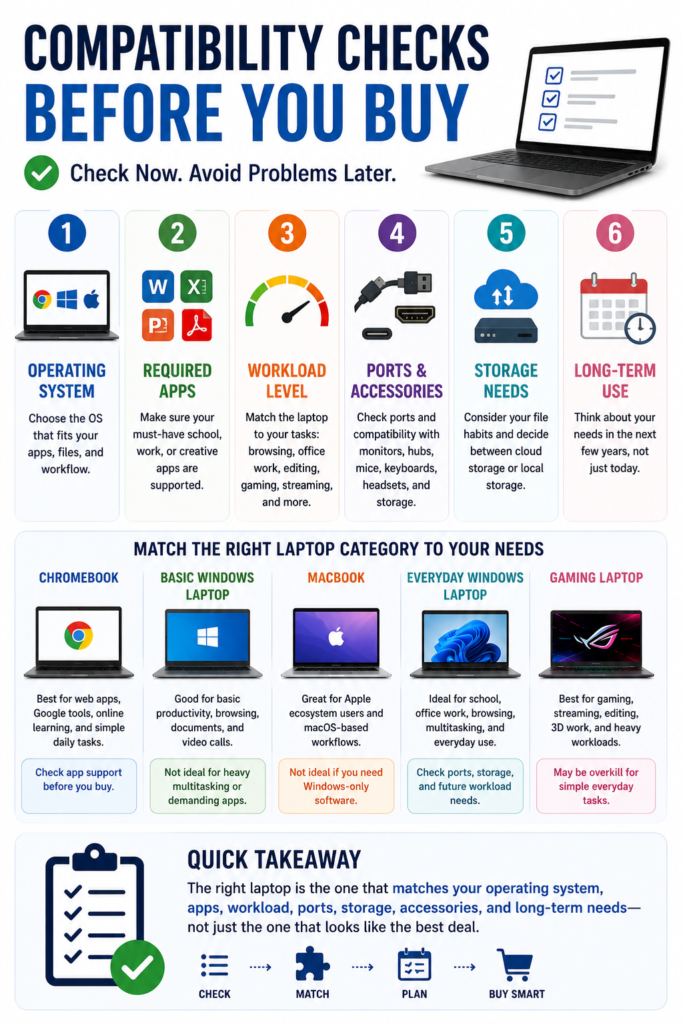
One of the easiest ways to avoid common laptop buying mistakes is to check compatibility before buying. A laptop can look like the right choice, but it may still become frustrating if it does not support your apps, operating system needs, accessories, ports, external display setup, or daily workflow.
Compatibility is not only about whether the laptop turns on and works. It is about whether the laptop works well for the way you actually study, work, browse, create, or play. Before choosing a Chromebook, basic Windows laptop, MacBook, everyday Windows laptop, or gaming laptop, check the details that affect your real use.
| Compatibility Check | Why It Matters | What to Confirm Before Buying |
|---|---|---|
| Operating system | The wrong system can create app and workflow problems. | Confirm whether you need ChromeOS, Windows, or macOS. |
| Required apps | School, work, or creative tools may not work the same way across every laptop type. | List your must-have apps before choosing the laptop category. |
| Workload level | A basic laptop may feel limiting if your tasks become heavier. | Think about browsing, documents, multitasking, gaming, editing, and streaming. |
| Ports and accessories | You may need hubs, adapters, monitors, mice, keyboards, or storage devices. | Check what accessories you connect every week. |
| Long-term use | A laptop that fits today may not fit your future school, work, or creative needs. | Choose a category that still makes sense over the next few years. |
For a Chromebook-style laptop such as the Lenovo IdeaPad Chromebook / Lenovo IdeaPad Slim 3 related Amazon listing, the main compatibility check is app support. This category can make sense for web apps, Google Docs, email, online learning, and simple browser-based work. But if you need Windows-only software or offline desktop apps, check carefully before buying.
For a basic Windows laptop such as the HP Stream BrightView N4120 Graphics related Amazon listing, the main check is workload fit. A Windows environment may be useful, but that does not automatically mean the laptop category is right for heavy multitasking, gaming, editing, streaming, or demanding software.
For a MacBook such as the Apple 2026 MacBook 15-inch Laptop related Amazon listing, the main check is whether macOS fits your apps and workflow. A MacBook can be a strong choice for Apple ecosystem users, but it may not be the best fit if your school or work depends on Windows-only tools.
For an everyday Windows laptop such as the ASUS Vivobook 14 / i3-1115G4 Graphics related Amazon listing, the main check is whether it fits your daily productivity routine. Think about documents, browser tabs, meetings, storage habits, accessories, and long-term school or office needs.
For a gaming laptop such as the ASUS ROG Strix Gaming Laptop related Amazon listing, the main check is whether you actually need performance headroom. A gaming laptop can make sense for games, streaming, creative work, and heavier workloads. But if your daily tasks are simple, it may be more laptop than you need.
It also helps to check your setup before buying. If you plan to use an external monitor, USB-C hub, wireless mouse, keyboard, storage drive, headset, or laptop case, make sure the laptop category fits those accessories. A laptop that seems fine on its own may feel less convenient if it does not support the setup you want.
The safest buying habit is to write down your must-have apps, operating system, workload, accessories, ports, storage habits, and future needs before comparing product names. If a laptop does not match those basics, it may become the wrong choice even if it looks appealing.
Quick takeaway: before buying a laptop, check operating system, required apps, workload, ports, accessories, storage habits, and long-term use. Compatibility problems usually start when the laptop category does not match your real workflow.
FAQ
What are the most common laptop buying mistakes?
The most common laptop buying mistakes are choosing the wrong operating system, buying too little performance for your workload, buying too much laptop for simple tasks, ignoring required apps, and forgetting ports, storage, accessories, and long-term needs.
For example, a Chromebook-style laptop such as the Lenovo IdeaPad Chromebook / Lenovo IdeaPad Slim 3 related Amazon listing can be practical for online learning and browser-based work, but it may not fit users who need Windows-only software. A basic Windows laptop such as the HP Stream BrightView N4120 Graphics related Amazon listing can fit light Windows tasks, but it may feel limiting if your workload grows.
The safest way to avoid these mistakes is to choose by real use case first. Check your operating system, required apps, workload, ports, storage habits, accessories, and long-term plans before comparing product names.
How do I avoid buying the wrong laptop?
To avoid buying the wrong laptop, start by listing what you actually do every week. Include school apps, work software, browser tools, video calls, documents, creative apps, gaming, streaming, storage needs, and accessories.
Then choose the laptop category that matches those needs. If most of your work is online, a Chromebook category may be enough. If you need simple Windows use, a basic Windows laptop may fit. If you prefer macOS and Apple ecosystem tools, a MacBook may make more sense. If you want balanced Windows productivity, an everyday Windows laptop may be more practical. If you need gaming, streaming, creative work, or heavier workloads, a gaming laptop category may be worth considering.
Do not choose only by price, brand, appearance, or category hype. A laptop should fit your apps, operating system, workload, and future needs.
Should I choose a Chromebook, Windows laptop, MacBook, or gaming laptop?
Choose a Chromebook if your work is mostly online and browser-based. The Lenovo IdeaPad Chromebook / Lenovo IdeaPad Slim 3 related Amazon listing fits users who mainly need web browsing, Google Docs, email, video calls, online learning, and simple cloud-based tasks.
Choose a Windows laptop if you need Windows apps, a familiar Windows environment, or general productivity. The HP Stream BrightView N4120 Graphics related Amazon listing fits basic Windows use, while the ASUS Vivobook 14 / i3-1115G4 Graphics related Amazon listing fits a more everyday Windows productivity direction.
Choose a MacBook if your workflow fits macOS and Apple ecosystem tools. The Apple 2026 MacBook 15-inch Laptop related Amazon listing is the MacBook option in this series. Choose a gaming laptop if performance-heavy tasks matter. The ASUS ROG Strix Gaming Laptop related Amazon listing fits users who need gaming, streaming, creative work, or heavier workloads.
Is a gaming laptop a mistake for everyday use?
A gaming laptop is not always a mistake for everyday use, but it can be unnecessary if your daily tasks are simple. If you mostly browse the web, write documents, attend video calls, check email, and use basic apps, a gaming laptop may be more than you need.
The ASUS ROG Strix Gaming Laptop related Amazon listing makes more sense if your workload includes gaming, streaming, editing, creative work, or heavier multitasking. It is the performance-focused category in this series.
The mistake is not buying a gaming laptop. The mistake is buying performance without a real performance need. If your tasks are light, a Chromebook, basic Windows laptop, MacBook, or everyday Windows laptop may be a more practical category.
What should I check before buying a laptop?
Before buying a laptop, check your required apps, operating system, workload, ports, storage habits, accessories, and long-term needs. These checks help you avoid choosing a laptop that looks good but does not fit your real routine.
For operating system, decide whether ChromeOS, Windows, or macOS fits your software. For workload, think about whether you only browse and write documents, or whether you also game, stream, edit, create, or multitask heavily. For setup, check whether you need an external monitor, USB-C hub, mouse, keyboard, storage device, headset, or laptop case.
You should also think beyond today. A laptop that fits this semester, this job, or this simple task list may feel limiting if your school, work, apps, or creative needs grow later.
Quick takeaway: avoid laptop buying mistakes by checking apps, operating system, workload, setup needs, and long-term fit before buying. The best laptop is not the one that looks strongest — it is the one that matches your real use.
Final Thought
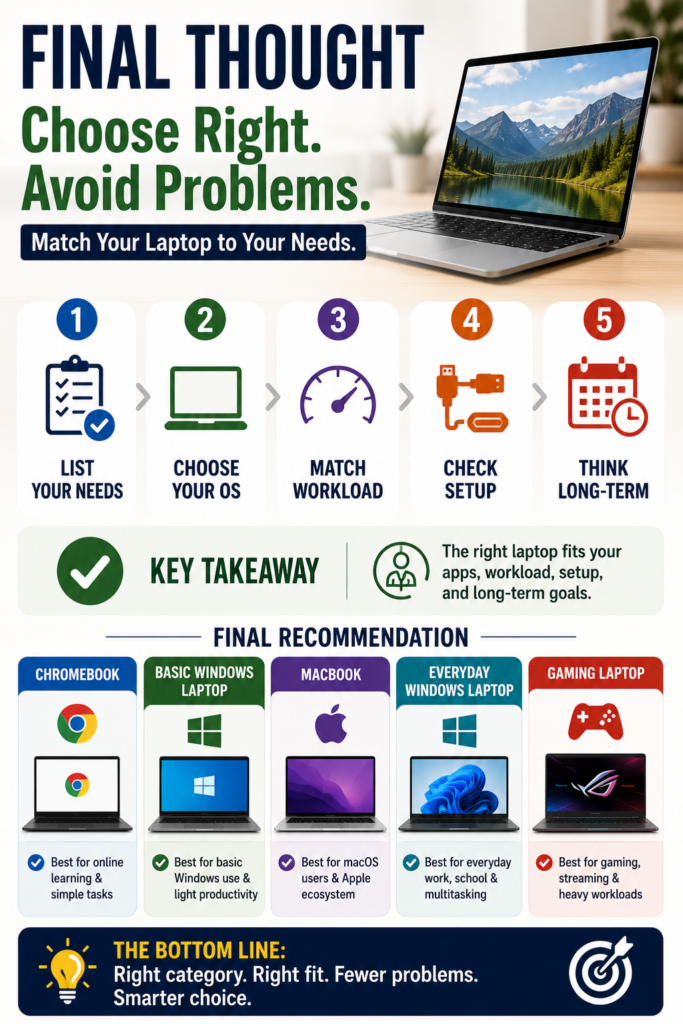
Avoiding common laptop buying mistakes is not about finding a laptop with zero problems. It is about choosing a laptop category that fits your real apps, operating system, workload, setup needs, and long-term plans before you buy.
Many laptop problems start when the buyer chooses the wrong type of laptop. A Chromebook can be practical for online learning and browser-based work, but it may not fit users who need Windows-only apps. A basic Windows laptop can be useful for light tasks, but it may feel limiting if your workload grows. A MacBook can be a strong fit for Apple ecosystem users, but it may not be right if your daily tools depend on Windows.
A gaming laptop can make sense for gaming, streaming, creative work, and heavier workloads, but it can also be more laptop than you need if your routine is simple. An everyday Windows laptop can be a balanced choice for school, work, browsing, and productivity, but it still needs to match your apps, ports, storage habits, and future needs.
| If Your Main Need Is… | Better Category to Consider | Example from This Series |
|---|---|---|
| Online learning and simple browser-based tasks | Chromebook-style laptop | Lenovo IdeaPad Chromebook / Lenovo IdeaPad Slim 3 related Amazon listing |
| Light Windows use | Basic Windows laptop | HP Stream BrightView N4120 Graphics related Amazon listing |
| macOS and Apple ecosystem workflow | MacBook | Apple 2026 MacBook 15-inch Laptop related Amazon listing |
| Everyday Windows productivity | Everyday Windows laptop | ASUS Vivobook 14 / i3-1115G4 Graphics related Amazon listing |
| Gaming, streaming, creative work, or heavier workloads | Gaming laptop | ASUS ROG Strix Gaming Laptop related Amazon listing |
The safest buying process is simple: list your required apps, choose the right operating system, match the laptop category to your workload, check ports and accessories, then think about whether the laptop will still fit your needs over the next few years.
Do not buy only by price, brand, appearance, or category hype. A cheaper laptop is not always the smarter choice if it cannot support your apps. A more powerful laptop is not always the better choice if you do not need the performance. The right laptop is the one that fits the way you actually study, work, browse, create, or play.
Final recommendation: choose the Lenovo IdeaPad Chromebook if your work is mostly online, the HP Stream if you need basic Windows use, the Apple 2026 MacBook if you prefer macOS and Apple ecosystem workflows, the ASUS Vivobook 14 if you want balanced everyday Windows productivity, and the ASUS ROG Strix Gaming Laptop if gaming, streaming, creative work, or heavier workloads are your priority. The best way to avoid laptop problems is to match the laptop category to your real needs before you buy.
Read our “How to Choose the Right Laptop” guide for more information.