Table of Contents
Quick Comparison Table
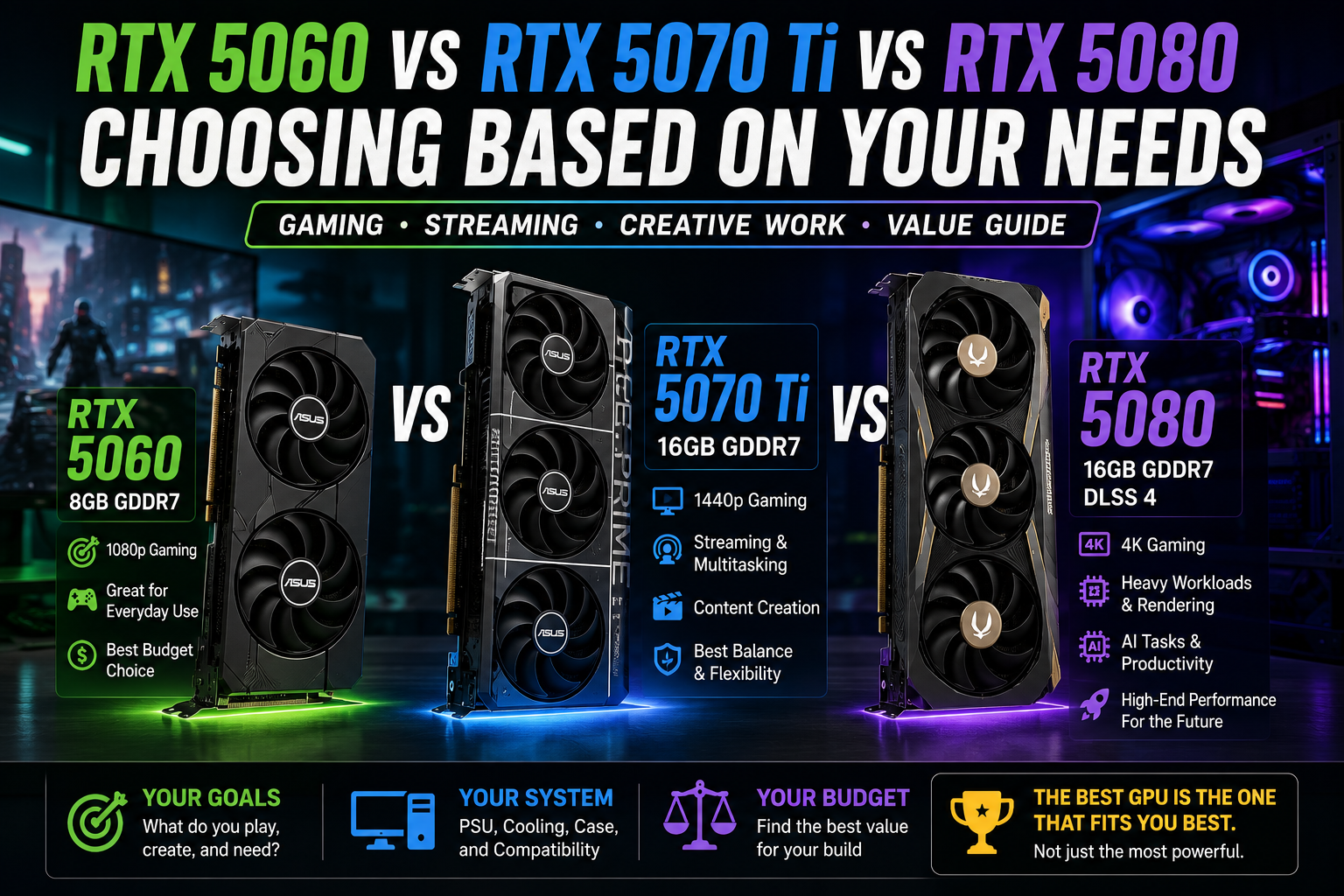
If you are comparing RTX 5060 vs RTX 5070 Ti vs RTX 5080, the best choice depends on what you actually need from your graphics card. Instead of choosing only by model number, start with your monitor resolution, game settings, creative workload, case space, and how long you plan to keep the card.
The RTX 5060 is the more practical choice for users who want a modern GPU without moving into a higher-end build. The RTX 5070 Ti is the stronger middle option for users who want more headroom for demanding games and creative work. The RTX 5080 is the most premium option in this comparison, mainly for users who want higher-end performance potential and a longer upgrade cycle.
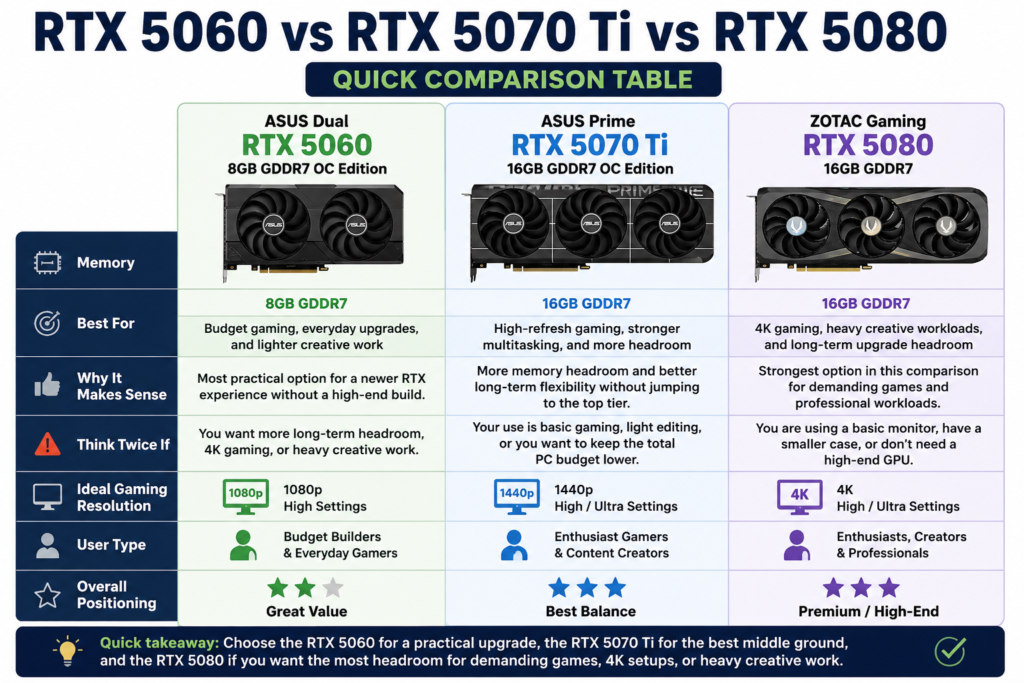
| Graphics Card | Confirmed Memory | Best For | Why It Makes Sense | Think Twice If |
|---|---|---|---|---|
| ASUS Dual NVIDIA GeForce RTX 5060 8GB GDDR7 OC Edition | 8GB GDDR7 | Budget-focused gaming, everyday PC upgrades, and lighter creative work | It is the most practical option if you want a newer RTX card without building around a higher-end GPU. | You want more long-term headroom for heavier gaming, 4K displays, or demanding creative workloads. |
| ASUS SFF-Ready Prime NVIDIA GeForce RTX 5070 Ti 16GB GDDR7 OC Edition | 16GB GDDR7 | High-refresh gaming, stronger multitasking, and users who want a safer middle option | It gives you more memory headroom than the RTX 5060 while avoiding the jump to the highest-end option in this comparison. | Your main use is basic gaming, light editing, or you are trying to keep the total PC budget lower. |
| ZOTAC Gaming GeForce RTX 5080 Solid CORE OC DLSS 4 16GB GDDR7 | 16GB GDDR7 | 4K gaming setups, heavier creative workflows, and users who want more upgrade headroom | It is the strongest option in this comparison for users who want a more premium GPU tier and do not want to upgrade again soon. | You are using a basic monitor, have a smaller case, or do not need a high-end GPU for your actual workload. |
For most users, the RTX 5060 makes sense if the goal is a simple and more affordable upgrade. The RTX 5070 Ti is the better balance point if you want stronger long-term flexibility. The RTX 5080 is easier to justify when your PC is built around heavier gaming, creative workloads, or a higher-end display setup.
Before choosing, also check your power supply, case clearance, cooling setup, and monitor resolution. A more powerful graphics card is not always the better purchase if the rest of your system cannot support it properly.
Quick takeaway: Choose the RTX 5060 for a practical upgrade, the RTX 5070 Ti for the best middle-ground option, and the RTX 5080 if you want the most headroom for demanding games, 4K setups, or heavier creative work.
RTX 5060 vs RTX 5070 Ti vs RTX 5080: Key Differences
When comparing RTX 5060 vs RTX 5070 Ti vs RTX 5080, the biggest differences are not just about raw performance. For most buyers, the more important questions are how much GPU headroom you need, what type of monitor you use, whether you do creative work, and how long you want the card to stay relevant before the next upgrade.
The ASUS Dual NVIDIA GeForce RTX 5060 8GB GDDR7 OC Edition is the entry point in this comparison. It is the most practical option if you want a newer RTX graphics card for everyday gaming, general PC upgrades, and lighter creative use. With 8GB GDDR7 memory, it is better suited for users who do not need a high-end GPU or a more expensive performance-focused build.
The ASUS SFF-Ready Prime NVIDIA GeForce RTX 5070 Ti 16GB GDDR7 OC Edition sits in the middle. Its biggest advantage in this comparison is stronger long-term flexibility, especially because it has 16GB GDDR7 memory. That makes it easier to recommend for users who want more breathing room for demanding games, higher-resolution monitors, multitasking, and creative workloads without jumping directly to the RTX 5080 tier.
The ZOTAC Gaming GeForce RTX 5080 Solid CORE OC DLSS 4 16GB GDDR7 is the highest-end option among these three cards. It is the better fit for users building around a more premium PC setup, especially if the goal is 4K gaming, heavier content creation, AI-related workloads, or a longer upgrade cycle. It also uses 16GB GDDR7 memory, but the main reason to choose it is not just memory capacity. It is for users who want the strongest option in this comparison and are prepared to build the rest of the system around it.
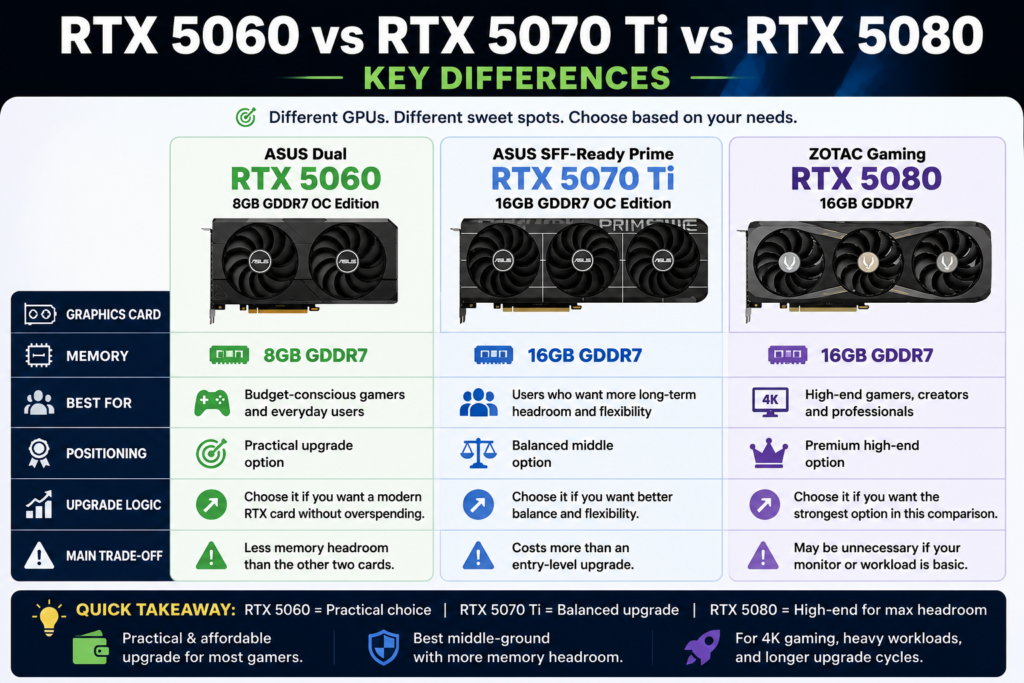
| Key Difference | RTX 5060 | RTX 5070 Ti | RTX 5080 |
|---|---|---|---|
| Positioning | Practical upgrade option | Balanced middle option | Premium high-end option |
| Confirmed Memory | 8GB GDDR7 | 16GB GDDR7 | 16GB GDDR7 |
| Best Fit | Budget-conscious gamers and everyday users | Users who want more long-term headroom | Users building a higher-end gaming or creator PC |
| Upgrade Logic | Choose it if you want a modern RTX card without overspending | Choose it if you want better balance and flexibility | Choose it if you want the strongest option in this comparison |
| Main Trade-Off | Less memory headroom than the other two cards | Costs more than an entry-level upgrade | May be unnecessary if your monitor or workload is basic |
The easiest way to separate these three cards is by buyer type. The RTX 5060 is for users who want a practical upgrade. The RTX 5070 Ti is for users who want a safer middle ground with more memory headroom. The RTX 5080 is for users who already know they need a higher-end card and do not want to compromise as quickly.
This also means the most expensive option is not automatically the best choice for every setup. If you use a basic monitor, play lighter games, or do not run heavy creative workloads, the RTX 5080 may be more GPU than you actually need. On the other hand, if you want more long-term flexibility, the RTX 5060 may feel more limited sooner than the RTX 5070 Ti or RTX 5080.
Quick takeaway: The RTX 5060 is the practical choice, the RTX 5070 Ti is the balanced upgrade, and the RTX 5080 is the high-end option for users who need the most headroom. The right choice depends less on the model number alone and more on your monitor, workload, budget direction, and upgrade timeline.
Best Choice for Different Users
When choosing between RTX 5060 vs RTX 5070 Ti vs RTX 5080, the best option depends on the type of user you are, not just the highest model number. A budget gamer, a high-refresh 1440p player, and a creator working with heavier projects should not all choose the same graphics card.
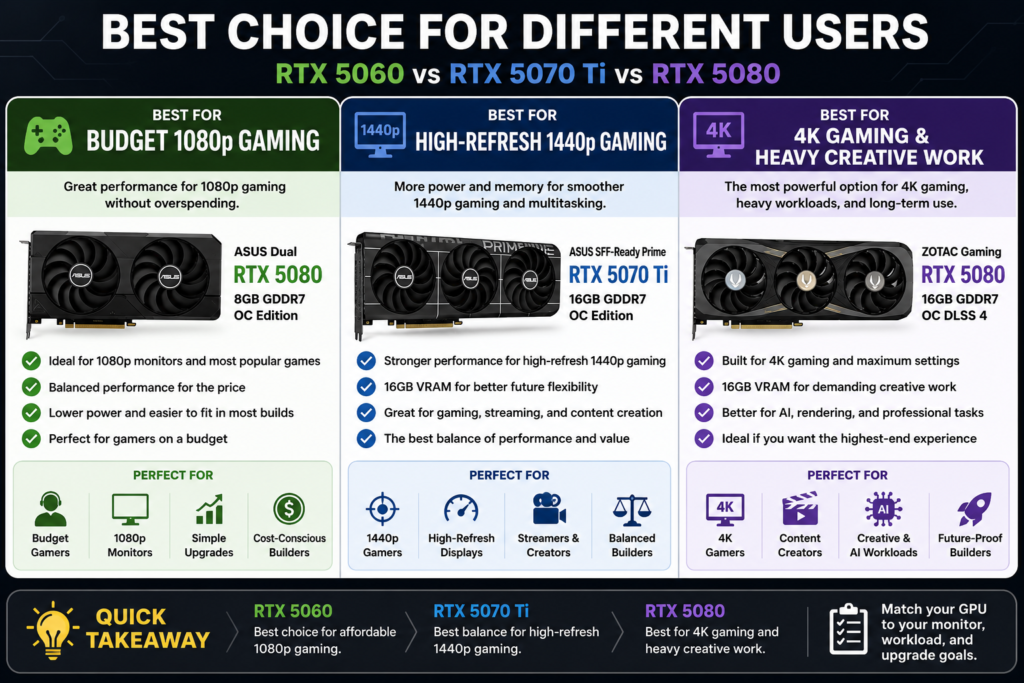
The easiest way to decide is to start with your monitor, your workload, and how long you want to keep the GPU. The ASUS Dual RTX 5060 is easier to justify for a practical 1080p-focused setup. The ASUS SFF-Ready Prime RTX 5070 Ti makes more sense if you want stronger headroom for 1440p gaming and mixed workloads. The ZOTAC Gaming RTX 5080 is the better fit if you are building a higher-end PC for 4K gaming, heavier creative work, or a longer upgrade cycle.
Best for Budget 1080p Gaming
For budget-focused 1080p gaming, the ASUS Dual NVIDIA GeForce RTX 5060 8GB GDDR7 OC Edition is the most practical choice in this comparison. It is better suited for users who want a modern RTX graphics card without building an expensive high-end system around the GPU.
This card makes the most sense if you play on a 1080p monitor, prefer a simpler upgrade path, and do not need the extra headroom of a higher-tier card. Its confirmed 8GB GDDR7 memory is enough to position it as the entry option here, especially for users who are upgrading from an older or lower-end graphics card.
The trade-off is long-term flexibility. If you want to move into heavier games, higher-resolution textures, larger creative projects, or a higher-resolution monitor later, the RTX 5060 may feel more limited than the RTX 5070 Ti or RTX 5080. For a basic 1080p-focused gaming setup, though, it is the easiest card to justify.
Best for High-Refresh 1440p Gaming
For high-refresh 1440p gaming, the ASUS SFF-Ready Prime NVIDIA GeForce RTX 5070 Ti 16GB GDDR7 OC Edition is the safer middle option. It gives you more memory headroom than the RTX 5060 while avoiding the jump to the highest-end RTX 5080.
This is the better fit if you want smoother gameplay potential at higher settings, more breathing room for demanding games, and stronger flexibility for multitasking or content creation. Its confirmed 16GB GDDR7 memory also makes it more comfortable for users who do not want to feel boxed in too quickly after upgrading.
The RTX 5070 Ti is not the cheapest path, so it may be unnecessary if you only play lighter games or use a basic 1080p display. But for users who want a balanced gaming PC that can handle more demanding use cases, it is the most reasonable middle ground in this comparison.
Best for 4K Gaming and Heavy Creative Work
For 4K gaming and heavier creative work, the ZOTAC Gaming GeForce RTX 5080 Solid CORE OC DLSS 4 16GB GDDR7 is the strongest option among these three cards. It is the better fit for users who are building a higher-end PC and want more GPU headroom from the start.
This card makes sense if you use a 4K monitor, work with heavier creative projects, run demanding visual workloads, or want to delay your next GPU upgrade for longer. Like the RTX 5070 Ti, it has confirmed 16GB GDDR7 memory, but the reason to choose it is its higher-end positioning in this comparison.
The main risk is overbuying. If your monitor, CPU, power supply, case airflow, or actual workload does not need a high-end GPU, the RTX 5080 may not give you the best value for your setup. It is best for users who already know they need a premium GPU tier, not for buyers who only want a simple gaming upgrade.
Quick takeaway: Choose the RTX 5060 if you want a practical 1080p gaming upgrade, the RTX 5070 Ti if you want the best middle ground for high-refresh 1440p gaming, and the RTX 5080 if you need the most headroom for 4K gaming, heavy creative work, or a longer upgrade cycle.
Gaming, Streaming, and Creative Workloads
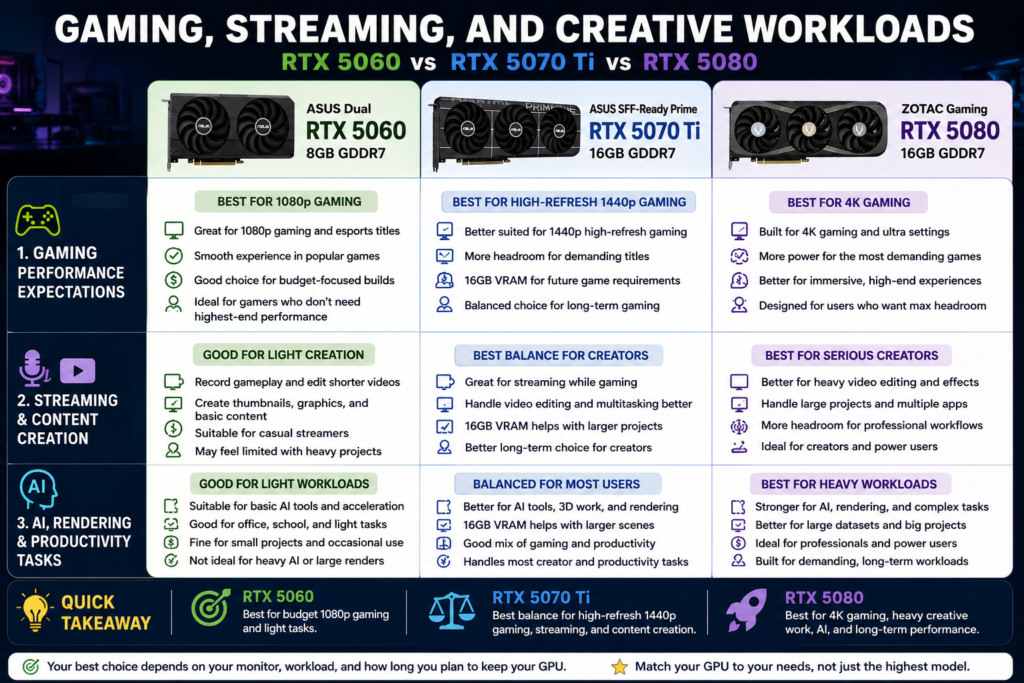
When comparing RTX 5060 vs RTX 5070 Ti vs RTX 5080, gaming is only one part of the decision. Many users also stream, record gameplay, edit videos, create thumbnails, run AI-assisted tools, or work with visual projects. That is why the best graphics card is not always the cheapest option or the highest-end option. It depends on how much pressure your daily workload puts on the GPU.
The ASUS Dual RTX 5060 is the more practical option for users who mainly play games and do lighter creative tasks. The ASUS SFF-Ready Prime RTX 5070 Ti is better for users who want more breathing room for gaming, streaming, editing, and multitasking. The ZOTAC Gaming RTX 5080 is the better match for users who expect heavier creative workloads, 4K gaming, AI-related tasks, or a longer upgrade cycle.
Gaming Performance Expectations
For gaming, the ASUS Dual NVIDIA GeForce RTX 5060 8GB GDDR7 OC Edition is best viewed as the practical entry option in this comparison. It makes the most sense for users focused on 1080p gaming, everyday esports titles, popular single-player games, and general PC upgrades. It is not the card to choose if you already know you want a higher-resolution setup or more long-term GPU headroom.
The ASUS SFF-Ready Prime NVIDIA GeForce RTX 5070 Ti 16GB GDDR7 OC Edition is the stronger choice for users who want a more flexible gaming experience. Its confirmed 16GB GDDR7 memory gives it more room than the RTX 5060 for higher-resolution textures, demanding games, and future upgrades. This makes it the safer middle option if you want to build around a 1440p-focused gaming setup.
The ZOTAC Gaming GeForce RTX 5080 Solid CORE OC DLSS 4 16GB GDDR7 is the highest-end option here. It is better suited for users who want a more premium gaming setup, especially if they are targeting 4K displays, heavier game settings, or a longer time before the next GPU upgrade. It may be unnecessary for users who only play lighter games or use a basic 1080p monitor.
| Gaming Use Case | Best Match | Reason |
|---|---|---|
| Practical 1080p gaming | RTX 5060 | Better fit for budget-focused gamers and simpler upgrades |
| High-refresh 1440p gaming | RTX 5070 Ti | More memory headroom and better long-term flexibility |
| 4K gaming and premium setups | RTX 5080 | Best fit for users who want the strongest option in this comparison |
Streaming and Content Creation
Streaming and content creation change the decision because the GPU may need to support more than just the game itself. A creator may have a game, recording software, browser tabs, editing tools, overlays, and background apps open at the same time. This is where extra GPU headroom becomes more useful.
The RTX 5060 can still make sense for lighter content creation. It is a reasonable pick if you mainly record basic gameplay clips, edit short videos, create simple thumbnails, or use your PC for casual streaming. The risk is that it may feel more limited if your projects become heavier or if you start combining gaming, recording, and editing more often.
The RTX 5070 Ti is the better balance for users who want to game and create content on the same machine. Its 16GB GDDR7 memory gives it more flexibility for editing timelines, higher-resolution assets, and heavier multitasking. For many users, this is the better long-term choice than buying the entry option and needing to upgrade sooner.
The RTX 5080 is easier to justify if your content creation workload is already serious. If you work with larger video projects, heavier visual assets, multiple creative apps, or a more demanding production workflow, the higher-end card gives you more room to grow. The main risk is paying for GPU power your workflow does not actually use.
AI, Rendering, and Productivity Tasks
AI, rendering, and productivity tasks are more difficult to judge than gaming because software requirements can vary a lot. Some programs depend heavily on the GPU, while others may be limited by the CPU, system memory, storage speed, or software optimization. That means you should not choose a graphics card only by model name.
The RTX 5060 is better for users who only need occasional GPU acceleration, light AI-assisted tools, basic productivity work, or smaller creative projects. It is not the safest choice if your work depends heavily on large visual projects, demanding rendering tasks, or more advanced AI workflows.
The RTX 5070 Ti is the more balanced option for mixed productivity. It gives you more memory headroom than the RTX 5060, which can matter when working with larger projects or heavier multitasking. It is a safer pick if your PC is used for both gaming and work, but you do not want to move all the way to the RTX 5080.
The RTX 5080 is the better match for users who already know their workload needs a higher-end GPU. This includes heavier rendering, more demanding creative projects, AI-related workloads, and professional-style multitasking. It is the strongest choice in this comparison, but it should be matched with the rest of your system so the GPU is not held back by weak cooling, limited power supply capacity, or an older platform.
Quick takeaway: Choose the RTX 5060 if your gaming and creative needs are light, the RTX 5070 Ti if you want a balanced card for gaming, streaming, and content creation, and the RTX 5080 if your setup is built around 4K gaming, heavier creative work, AI tasks, or long-term GPU headroom.
Power Supply, Cooling, and Case Compatibility
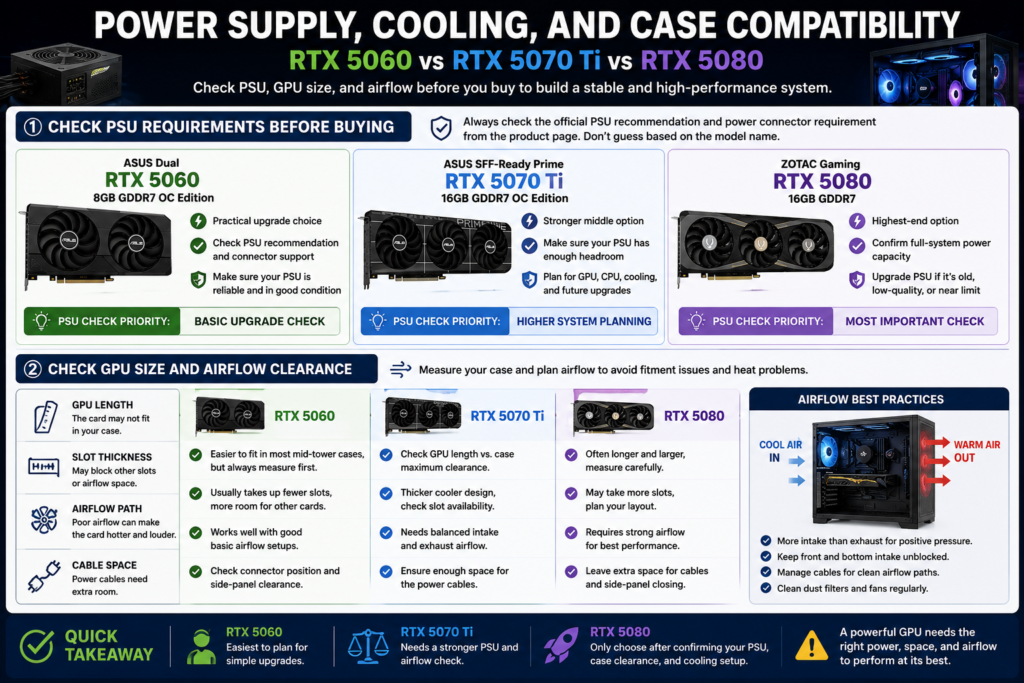
When comparing RTX 5060 vs RTX 5070 Ti vs RTX 5080, power supply, cooling, and case compatibility can matter as much as the GPU tier itself. A graphics card is not a standalone upgrade. It has to work with your power supply, case space, airflow path, motherboard layout, and the rest of your PC build.
The ASUS Dual RTX 5060 is the easiest card to consider for a more practical upgrade path, but you should still check your PSU and case before buying. The ASUS SFF-Ready Prime RTX 5070 Ti needs more attention because it is a stronger GPU tier and should be matched with proper airflow and power planning. The ZOTAC Gaming RTX 5080 should be treated as a high-end upgrade that requires the most careful system check before purchase.
Check PSU Requirements Before Buying
Before choosing any of these graphics cards, check the official power supply recommendation from the GPU manufacturer or product listing. Do not guess based only on the model name. A higher-tier card usually needs a stronger overall system plan, but the exact PSU requirement should always come from confirmed product information.
For the ASUS Dual NVIDIA GeForce RTX 5060 8GB GDDR7 OC Edition, the main question is whether your current power supply is suitable for a modern RTX upgrade. This card is the most practical option in the comparison, but that does not mean every older PSU is safe to reuse. Check the wattage recommendation, power connector requirement, PSU age, and whether your unit is from a reliable brand.
For the ASUS SFF-Ready Prime NVIDIA GeForce RTX 5070 Ti 16GB GDDR7 OC Edition, the PSU check becomes more important. This card is positioned as the stronger middle option, so buyers should make sure the power supply has enough headroom for the GPU, CPU, storage, fans, and future upgrades. A system that barely meets the minimum requirement may work on paper but still leave less room for long-term stability.
For the ZOTAC Gaming GeForce RTX 5080 Solid CORE OC DLSS 4 16GB GDDR7, do not treat the PSU as an afterthought. This is the highest-end option in this comparison, so it should be paired with a power supply that matches the full system, not just the graphics card. If your current PSU is old, low-quality, or already close to its limit, upgrading the power supply may be part of the real cost of choosing the RTX 5080.
| GPU Choice | PSU Check Priority | What to Confirm |
|---|---|---|
| RTX 5060 | Basic upgrade check | Confirm PSU recommendation, connector support, and PSU condition |
| RTX 5070 Ti | Higher system planning | Confirm power headroom for GPU, CPU, cooling, and future upgrades |
| RTX 5080 | Most important check | Confirm full-system power capacity and whether a PSU upgrade is needed |
Check GPU Size and Airflow Clearance
Case compatibility is another area where buyers can make expensive mistakes. A graphics card may be the right performance tier but still be the wrong physical fit for your PC case. Before buying, check the GPU length, slot thickness, case GPU clearance, front fan position, radiator placement, and whether the card will block other components.
The RTX 5060 is the easiest option to consider for simpler builds, but you should still measure your case. Even a practical GPU upgrade can become a problem if your case has limited clearance, poor cable routing, or weak airflow around the graphics card.
The RTX 5070 Ti needs more attention because it is the middle option for users who want stronger long-term flexibility. The ASUS SFF-Ready Prime model name suggests that this card is designed with smaller-form-factor compatibility in mind, but you should still check the exact dimensions against your own case. “SFF-ready” should not replace a real clearance check.
The RTX 5080 should be checked most carefully. Higher-end graphics cards are often paired with larger coolers, more demanding airflow needs, and heavier builds. Before choosing this card, make sure your case has enough physical space, enough intake and exhaust airflow, and enough room for clean cable routing.
Cooling also affects long-term comfort. A cramped case can make a powerful GPU louder, warmer, or harder to maintain. If your case has weak airflow, poor dust filtering, or limited fan placement, the RTX 5070 Ti or RTX 5080 may require more planning than a simple GPU swap.
| Compatibility Check | Why It Matters | What to Do Before Buying |
|---|---|---|
| GPU length | The card may not physically fit inside the case | Compare official GPU dimensions with case clearance |
| Slot thickness | The card may block nearby slots or airflow space | Check how many expansion slots the card occupies |
| Airflow path | Poor airflow can make the card run hotter and louder | Check intake fans, exhaust fans, and cable obstruction |
| Cable space | Power cables may need extra room near the side panel | Check connector position and side-panel clearance |
Quick takeaway: The RTX 5060 is the easiest upgrade to plan around, the RTX 5070 Ti needs a stronger PSU and airflow check, and the RTX 5080 should only be chosen after confirming your power supply, case clearance, cooling setup, and full-system compatibility.
Price-to-Value Decision Guide
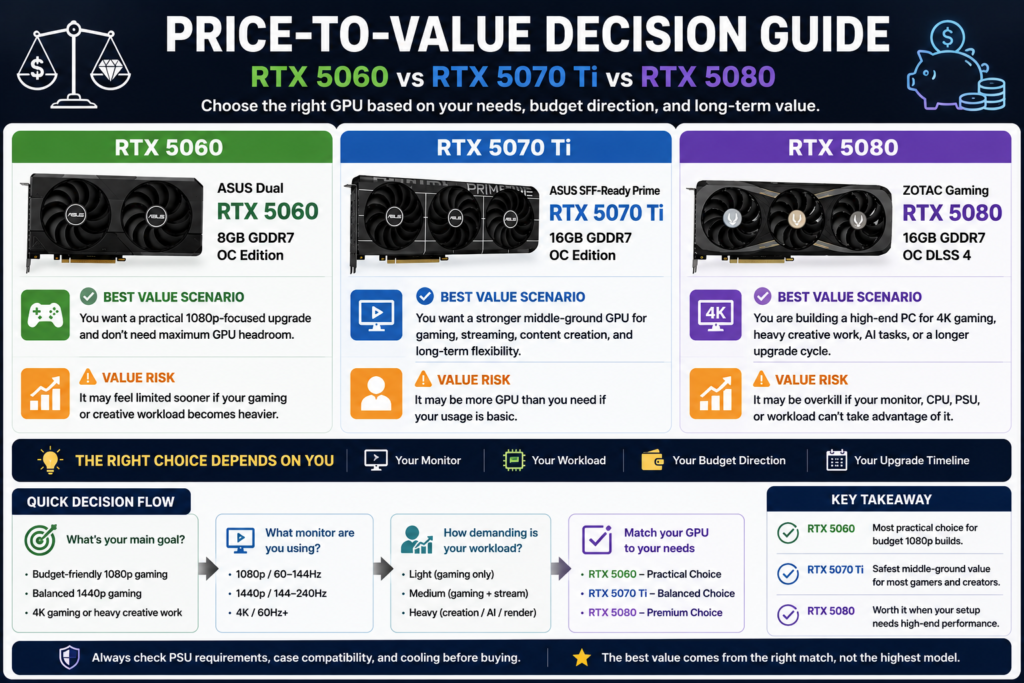
When comparing RTX 5060 vs RTX 5070 Ti vs RTX 5080, price-to-value should not only mean choosing the cheapest graphics card. A better way to think about value is to ask whether the GPU matches your monitor, workload, upgrade timeline, and total PC build. A card can be too weak for your needs, but it can also be more expensive than your setup actually requires.
The RTX 5060 makes the most sense when you want a practical upgrade and do not need high-end GPU headroom. The RTX 5070 Ti is the safer middle option if you want more flexibility without moving straight to the most premium card in this comparison. The RTX 5080 is worth considering when your setup can actually benefit from a higher-end GPU tier.
| GPU | Best Value Scenario | Value Risk |
|---|---|---|
| RTX 5060 | You want a practical 1080p-focused upgrade and do not need maximum GPU headroom. | It may feel limited sooner if your gaming or creative workload becomes heavier. |
| RTX 5070 Ti | You want a stronger middle-ground card for gaming, streaming, content creation, and longer-term flexibility. | It may be more GPU than you need if your usage is basic. |
| RTX 5080 | You are building a higher-end PC for 4K gaming, heavy creative work, AI tasks, or a longer upgrade cycle. | It may be overkill if your monitor, CPU, PSU, or workload cannot take advantage of it. |
When the RTX 5060 Makes More Sense
The ASUS Dual NVIDIA GeForce RTX 5060 8GB GDDR7 OC Edition makes more sense if your goal is a simple, practical graphics card upgrade. It is the easiest card to justify for users who mainly play at 1080p, use a standard gaming monitor, and do not need a higher-end GPU for heavy creative or professional workloads.
This is the better value direction if you care more about avoiding overspending than maximizing long-term headroom. For many everyday users, buying more GPU than they need can reduce overall value because the extra performance tier may not be fully used by their monitor, games, or workflow.
The main trade-off is future flexibility. With confirmed 8GB GDDR7 memory, the RTX 5060 is the entry option in this comparison. It can be a reasonable choice for a budget-focused build, but it is not the strongest choice if you expect to move into heavier games, larger creative projects, or higher-resolution displays later.
When the RTX 5070 Ti Is the Safer Middle Option
The ASUS SFF-Ready Prime NVIDIA GeForce RTX 5070 Ti 16GB GDDR7 OC Edition is the safer middle option if you want better long-term flexibility without jumping directly to the RTX 5080. It is easier to recommend for users who want one card that can handle gaming, streaming, content creation, and general productivity with more breathing room.
Its confirmed 16GB GDDR7 memory gives it more headroom than the RTX 5060, which can matter for higher-resolution textures, larger creative files, heavier multitasking, and future game requirements. This makes it a stronger value choice for users who do not want to upgrade again too soon.
The RTX 5070 Ti is not the right value choice for everyone. If you only play lighter games, use a basic 1080p monitor, or rarely do creative work, the extra GPU tier may not be necessary. But if you want a balanced card that gives you room to grow, this is the most sensible middle ground in the comparison.
When the RTX 5080 Is Worth Considering
The ZOTAC Gaming GeForce RTX 5080 Solid CORE OC DLSS 4 16GB GDDR7 is worth considering when your PC is built around demanding use cases. This includes 4K gaming, heavier video editing, rendering, AI-related workloads, professional-style multitasking, or a longer upgrade cycle.
The RTX 5080 is the strongest option in this comparison, but that does not automatically make it the best value for every buyer. It becomes a better value choice when your monitor, CPU, power supply, case airflow, and workload can actually take advantage of a higher-end GPU. If the rest of your system is not ready, the real cost may include more than just the graphics card.
This card is not ideal for users who only want a simple gaming upgrade. If your current setup is built around a basic monitor or lighter workloads, the RTX 5080 may deliver more GPU headroom than you can realistically use. It is best for users who already know they need a premium card and are willing to build the system around it.
Quick takeaway: Choose the RTX 5060 if you want the most practical upgrade, the RTX 5070 Ti if you want the safest middle-ground value, and the RTX 5080 if your setup can actually use a high-end GPU for 4K gaming, heavy creative work, AI tasks, or longer-term headroom.
FAQ
Is the RTX 5060 enough for gaming?
Yes, the RTX 5060 can be enough for gaming if your goal is a practical 1080p-focused setup. In this RTX 5060 vs RTX 5070 Ti vs RTX 5080 comparison, the ASUS Dual NVIDIA GeForce RTX 5060 8GB GDDR7 OC Edition is the most sensible choice for budget-conscious gamers, everyday PC upgrades, and users who do not need a high-end GPU.
The main limitation is long-term headroom. If you plan to move into heavier games, higher-resolution displays, larger creative projects, or more demanding multitasking, the RTX 5070 Ti or RTX 5080 may be a safer choice.
Is the RTX 5070 Ti better for 1440p gaming?
The RTX 5070 Ti is the better match for users who want a stronger 1440p-focused gaming setup. The ASUS SFF-Ready Prime NVIDIA GeForce RTX 5070 Ti 16GB GDDR7 OC Edition gives you more memory headroom than the RTX 5060, which can help with higher-resolution textures, demanding games, and longer-term flexibility.
It is not automatically the right choice for every buyer. If you mainly play lighter games on a basic 1080p monitor, the RTX 5060 may still make more sense. But for high-refresh 1440p gaming and mixed gaming-plus-creation use, the RTX 5070 Ti is the safer middle option.
Is the RTX 5080 overkill for most users?
The RTX 5080 can be overkill if your setup does not need a high-end graphics card. The ZOTAC Gaming GeForce RTX 5080 Solid CORE OC DLSS 4 16GB GDDR7 is the strongest option in this comparison, but that does not mean it is the best value for every PC build.
It makes more sense if you use a 4K monitor, run heavier creative workloads, work with AI-related tasks, or want a longer upgrade cycle. If your monitor, CPU, power supply, case airflow, or daily workload cannot take advantage of a higher-end GPU, the RTX 5080 may be more card than you actually need.
Should I choose RTX 5060, RTX 5070 Ti, or RTX 5080 for video editing?
For light video editing, the RTX 5060 can be enough if your projects are simple and your workflow is not too demanding. It is the most practical choice if you only edit shorter videos, create basic content, or occasionally use GPU acceleration.
For a stronger all-around editing setup, the RTX 5070 Ti is the better middle option because it has confirmed 16GB GDDR7 memory and gives you more room for larger files, heavier timelines, and multitasking. The RTX 5080 is worth considering if your editing work is heavier, includes larger projects, or overlaps with 4K footage, rendering, AI tools, or professional-style workloads.
Do I need a bigger power supply for RTX 5070 Ti or RTX 5080?
You may need a stronger power supply for the RTX 5070 Ti or RTX 5080, but you should not guess the exact requirement. Always check the official PSU recommendation from the product listing or manufacturer page before buying.
The RTX 5070 Ti should be matched with enough system headroom for the GPU, CPU, cooling, storage, and future upgrades. The RTX 5080 needs the most careful PSU check because it is the highest-end option in this comparison. If your current power supply is old, low-quality, or already close to its limit, a PSU upgrade may become part of the real cost.
Which GPU is better for a small PC case?
For a small PC case, the best choice depends on the exact GPU dimensions, slot thickness, airflow path, and cable clearance. Do not choose only by the GPU model name. You need to compare the official graphics card dimensions with your case clearance before buying.
The ASUS SFF-Ready Prime NVIDIA GeForce RTX 5070 Ti 16GB GDDR7 OC Edition is the model in this comparison that specifically includes “SFF-Ready” in its name, but you should still confirm the exact fit. The RTX 5060 may be easier to plan around for simpler builds, while the RTX 5080 needs the most careful case, airflow, and cable-space check.
Is VRAM important when choosing between these graphics cards?
Yes, VRAM is important, especially if you play demanding games, use higher-resolution textures, edit larger creative projects, or want more long-term flexibility. In this comparison, the ASUS Dual RTX 5060 has confirmed 8GB GDDR7 memory, while the ASUS SFF-Ready Prime RTX 5070 Ti and ZOTAC Gaming RTX 5080 both have confirmed 16GB GDDR7 memory.
That does not mean VRAM is the only factor. You should also consider your monitor resolution, workload, power supply, case airflow, and upgrade timeline. But if you want more headroom for future games and heavier creative use, the RTX 5070 Ti or RTX 5080 gives you more memory capacity than the RTX 5060.
Which graphics card should I buy for long-term use?
For long-term use, the RTX 5070 Ti is the safest middle option for most users because it offers stronger flexibility without jumping straight to the most premium card in this comparison. It is a better fit if you want one GPU for gaming, streaming, content creation, and future upgrades.
The RTX 5080 is better for long-term use if your setup is already built around 4K gaming, heavier creative workloads, AI-related tasks, or professional-style multitasking. The RTX 5060 is still a reasonable long-term choice for users who plan to stay with a practical 1080p-focused setup and do not need high-end GPU headroom.
Quick takeaway: For most buyers, the RTX 5060 is the practical budget choice, the RTX 5070 Ti is the safest long-term middle option, and the RTX 5080 is best for users who can actually use a higher-end GPU for 4K gaming, heavy creative work, or demanding productivity tasks.
Final Thought
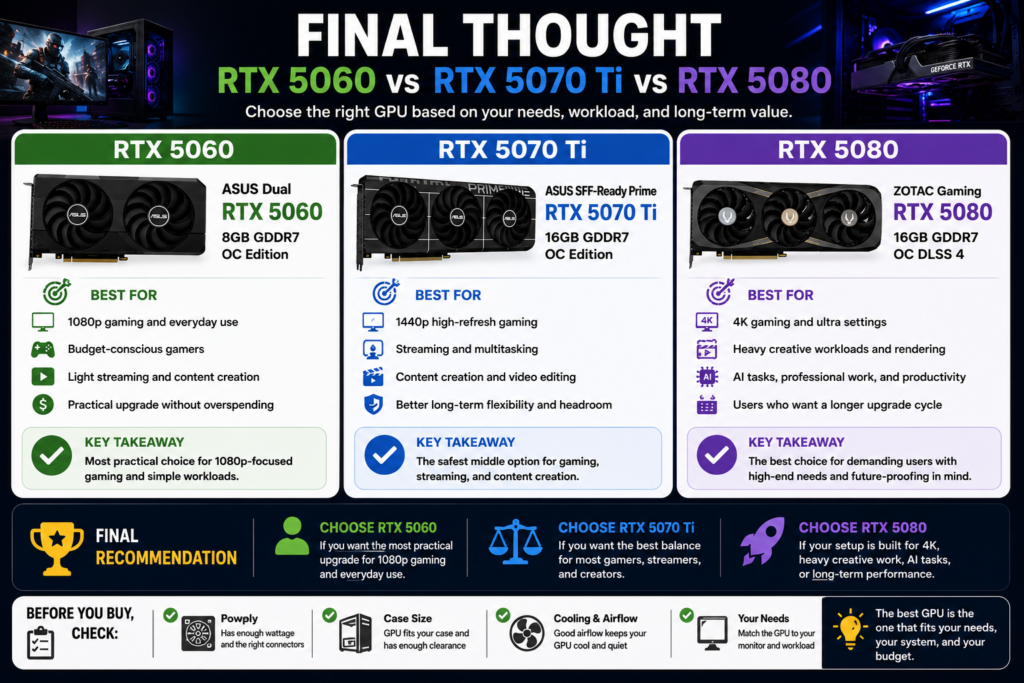
Choosing between RTX 5060 vs RTX 5070 Ti vs RTX 5080 is not just about picking the most powerful graphics card. The better choice depends on your monitor, workload, power supply, case compatibility, cooling setup, and how long you plan to keep the GPU before upgrading again.
The ASUS Dual NVIDIA GeForce RTX 5060 8GB GDDR7 OC Edition is the most practical option if you mainly want a modern RTX upgrade for 1080p gaming, everyday use, and lighter creative work. It makes the most sense for buyers who want to avoid overspending and do not need the extra headroom of a higher-tier graphics card.
The ASUS SFF-Ready Prime NVIDIA GeForce RTX 5070 Ti 16GB GDDR7 OC Edition is the safest middle option for most users. It gives you more memory headroom than the RTX 5060 and is easier to recommend for high-refresh 1440p gaming, streaming, content creation, multitasking, and longer-term flexibility.
The ZOTAC Gaming GeForce RTX 5080 Solid CORE OC DLSS 4 16GB GDDR7 is the better fit if you are building a higher-end PC around 4K gaming, heavier creative workloads, AI-related tasks, or a longer upgrade cycle. It is the strongest option in this comparison, but it only makes sense if the rest of your system can support and benefit from it.
| If You Want… | Choose This GPU | Why |
|---|---|---|
| A practical 1080p-focused upgrade | RTX 5060 | Best fit for budget-conscious gamers and everyday users |
| The safest balance for gaming and creation | RTX 5070 Ti | More memory headroom and better long-term flexibility |
| A high-end GPU for demanding workloads | RTX 5080 | Best fit for 4K gaming, heavy creative work, and longer upgrade cycles |
Final recommendation: choose the RTX 5060 if you want the most practical upgrade, choose the RTX 5070 Ti if you want the best balance for most gaming and creative needs, and choose the RTX 5080 only if your monitor, workload, power supply, case, and cooling setup are ready for a higher-end graphics card.