Table of Contents
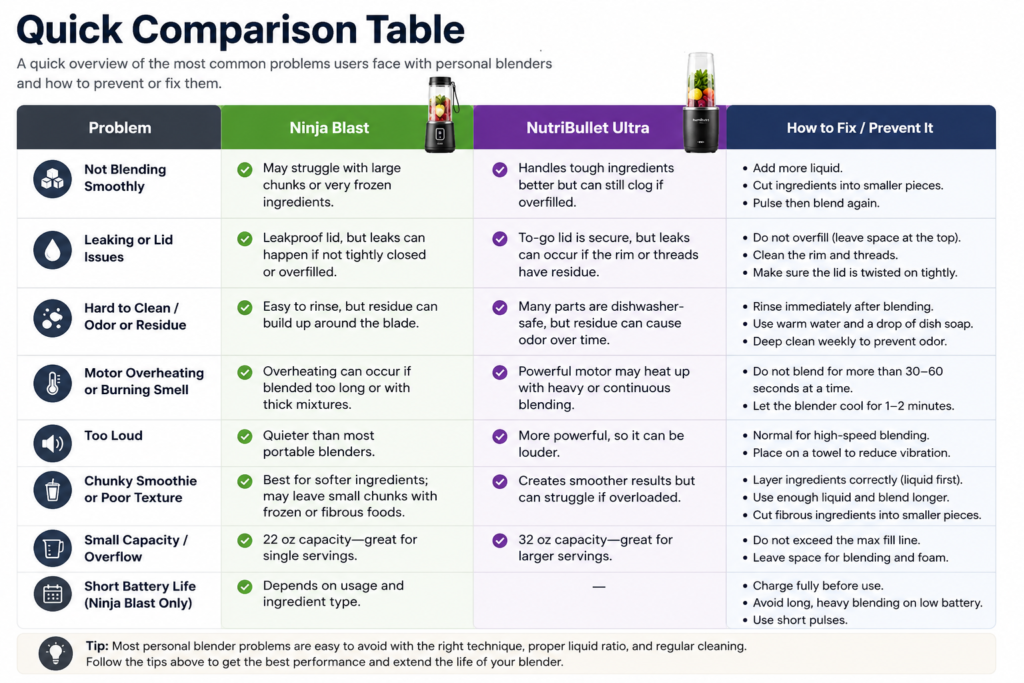
Quick Comparison Table
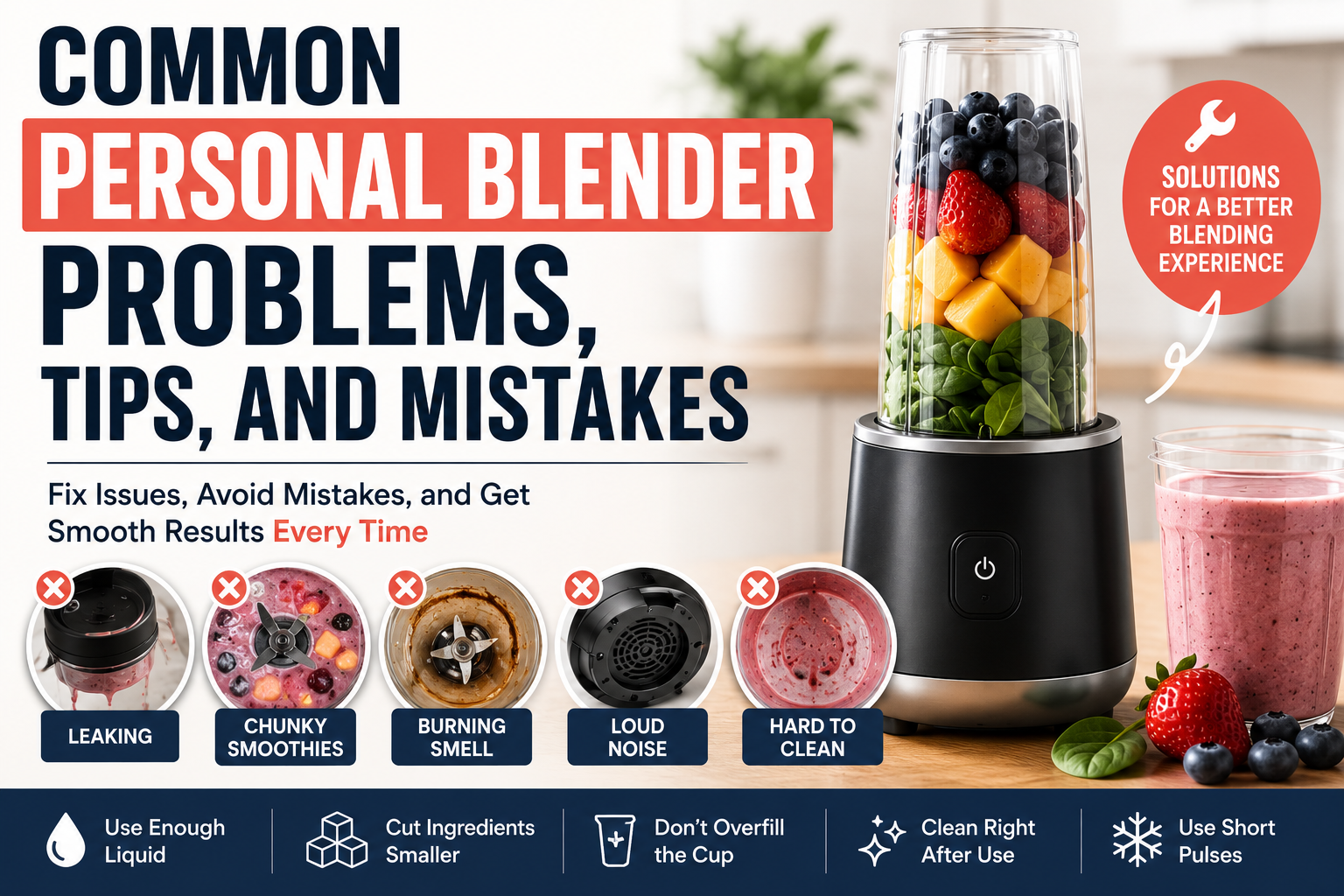
If you are dealing with personal blender problems, the issue is usually related to ingredient size, liquid amount, cup filling, cleaning habits, or motor strain. Most problems can be fixed by changing how you load the cup, how much liquid you use, and how quickly you clean the blender after each use.
This quick comparison table helps you identify the most common personal blender problems and what to do before assuming the blender is broken.
| Problem | Common Cause | Quick Fix |
|---|---|---|
| Smoothie is chunky or uneven | Not enough liquid, frozen pieces are too large, or ingredients are packed too tightly | Add more liquid, cut frozen fruit smaller, and blend in short pulses. |
| Blender leaks during use | Overfilled cup, loose lid, damaged seal, or ingredients above the max fill line | Stay below the max line, tighten the lid, and check the gasket before blending. |
| Burning smell or motor strain | Mixture is too thick, blender is overloaded, or motor runs too long | Stop blending, let the motor cool, add liquid, and blend in shorter cycles. |
| Bad smell or residue buildup | Cup or blade area was not rinsed right after use | Rinse immediately, wash the lid and seal area, and let parts dry fully. |
| Blender is very loud | Hard frozen ingredients, ice, unstable surface, or high motor load | Use smaller ice pieces, add liquid, and place the blender on a stable counter. |
| Ingredients get stuck near the blade | Wrong ingredient order or not enough space for movement | Add liquid first, then soft ingredients, then frozen items on top. |
| Cup is hard to clean | Thick smoothie residue dried inside the cup or lid | Rinse right after blending and use warm water with a small amount of dish soap. |
Before replacing your blender, check the basics first: liquid level, ingredient size, lid seal, cup capacity, and cleaning routine. These small habits solve many personal blender problems and help the blender last longer.
Common Personal Blender Problems and Quick Fixes
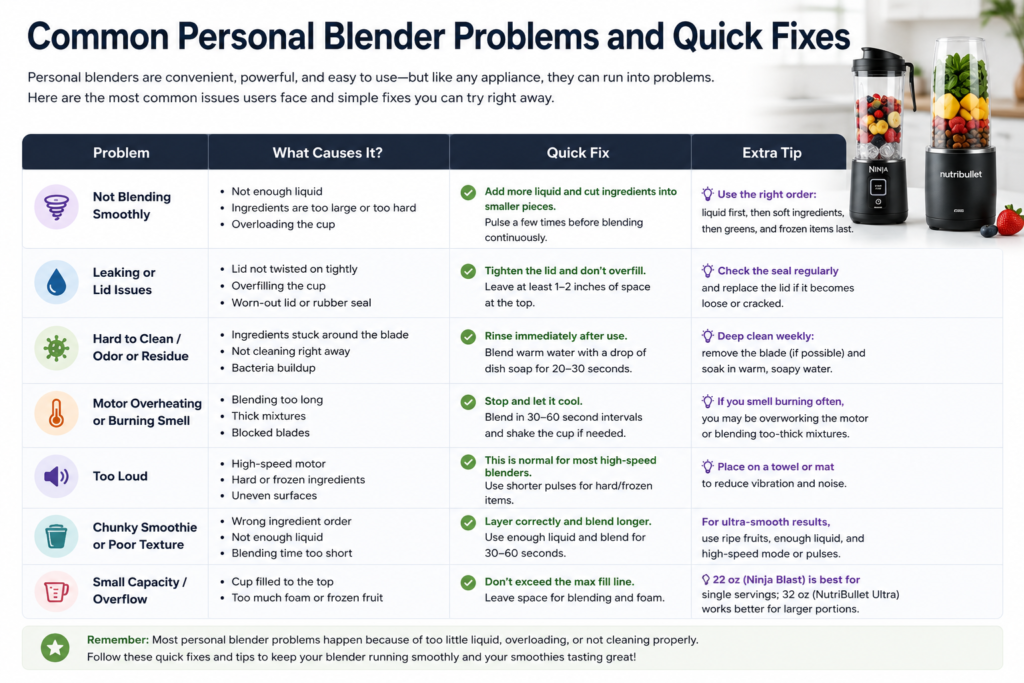
Most personal blender problems are not caused by a broken machine. In many cases, the issue comes from using too little liquid, overfilling the cup, adding ingredients in the wrong order, or blending hard frozen pieces that are too large for the motor and blade design.
Before replacing your blender, try these quick fixes first. Small changes in liquid amount, ingredient size, blending time, and cleaning habits can often improve texture, reduce leaking, and help your personal blender last longer.
| Problem | Why It Happens | Quick Fix |
|---|---|---|
| Chunky smoothie | Not enough liquid or frozen fruit pieces are too large | Add more liquid, cut ingredients smaller, and blend in short pulses. |
| Ingredients stuck near the blade | Ingredients are packed too tightly or layered in the wrong order | Add liquid first, then soft ingredients, then frozen items on top. |
| Blender leaking | Cup is overfilled, lid is loose, or the seal is dirty | Stay below the max fill line, tighten the lid, and clean the gasket area. |
| Burning smell | Mixture is too thick or the motor is running too long | Stop blending, let the motor cool, add liquid, and restart with shorter cycles. |
| Bad odor after use | Smoothie residue dried inside the lid, cup, or blade area | Rinse immediately after blending and let all parts dry fully. |
| Blender is too loud | Hard ingredients, ice, or an unstable surface increases vibration | Use smaller ice pieces, add liquid, and place the blender on a stable counter. |
| Cup is hard to clean | Thick smoothie residue sits too long before washing | Rinse right away with warm water and a small amount of dish soap. |
If your personal blender still struggles after these fixes, check the product manual for ingredient limits, maximum fill line, cleaning instructions, and recommended blending time. Some compact models are better for simple smoothies and protein shakes, while stronger plug-in models are better for frozen fruit, ice, and thicker blends.
Quick rule: if the blender sounds strained, smells hot, or stops blending smoothly, do not keep forcing it. Add liquid, reduce the ingredient load, blend in shorter cycles, and let the motor cool before trying again.
Why Your Personal Blender Is Not Blending Smoothly
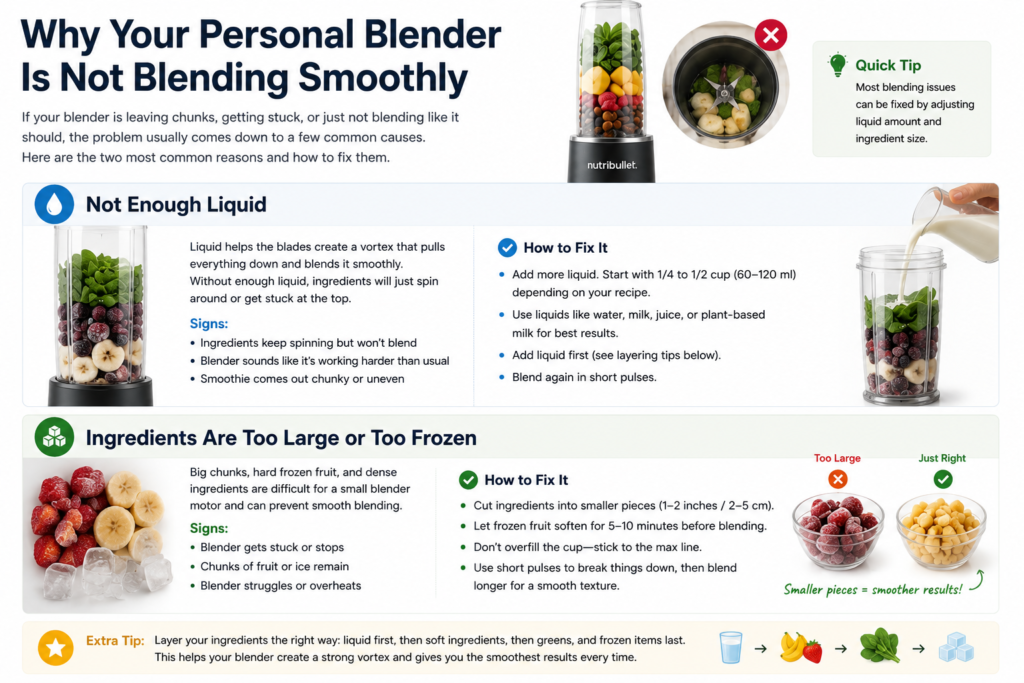
One of the most common personal blender problems is poor blending texture. If your smoothie comes out chunky, uneven, or stuck near the blade, the blender may not be broken. The issue is often caused by not enough liquid, oversized ingredients, frozen pieces that are too hard, or a cup that is packed too tightly.
A personal blender needs enough liquid and space inside the cup to move ingredients around the blades. When the mixture is too thick, the blades can spin without pulling ingredients down properly. This can leave frozen fruit, greens, protein powder, or oats stuck at the top or packed around the blade area.
| Blending Problem | Likely Cause | Quick Fix |
|---|---|---|
| Chunks of fruit remain after blending | Frozen fruit pieces are too large or too hard | Cut frozen fruit smaller and let it soften for a few minutes before blending. |
| Ingredients spin but do not blend evenly | Not enough liquid in the cup | Add more liquid and pulse before running a full blending cycle. |
| Smoothie is too thick | Too much frozen fruit, oats, nut butter, or protein powder | Reduce dense ingredients or add liquid slowly until the texture improves. |
| Food gets stuck near the blade | Ingredients are layered in the wrong order | Add liquid first, then soft fruit, then greens, then frozen ingredients last. |
| Blender sounds strained | Cup is overloaded or mixture is too dense | Stop blending, remove some ingredients, add liquid, and restart in short pulses. |
Not Enough Liquid
Not using enough liquid is one of the easiest personal blender problems to fix. Without enough liquid, the blades may not create proper movement inside the cup. This can cause ingredients to sit above the blade instead of blending into a smooth texture.
Start with a small amount of liquid, then add more if the smoothie looks too thick. Water, milk, almond milk, oat milk, coconut water, or juice can all help ingredients move more easily. For thick smoothies, protein shakes, and frozen fruit blends, adding liquid first usually gives better results.
A good rule is to add liquid before solid ingredients. Then add soft fruit, powders, greens, and frozen items last. This order helps the blades pull ingredients downward instead of forcing the motor to fight a dense mixture from the start.
Ingredients Are Too Large or Too Frozen
Large frozen fruit pieces, big ice cubes, and hard ingredients can make a personal blender struggle. Compact blenders are designed for single-serve drinks, but they still need properly sized ingredients to blend smoothly.
If your smoothie keeps coming out chunky, cut frozen fruit into smaller pieces, use smaller ice cubes, and avoid filling the cup too tightly. You can also let frozen fruit sit for a few minutes before blending. This makes it easier for the blades to break everything down.
For tougher blends, use short pulses first instead of running the blender continuously. Pulsing helps break down frozen pieces gradually and reduces motor strain. If the blender still struggles, add more liquid or blend in smaller batches.
Leaking, Lid Issues, and Cup Overfilling
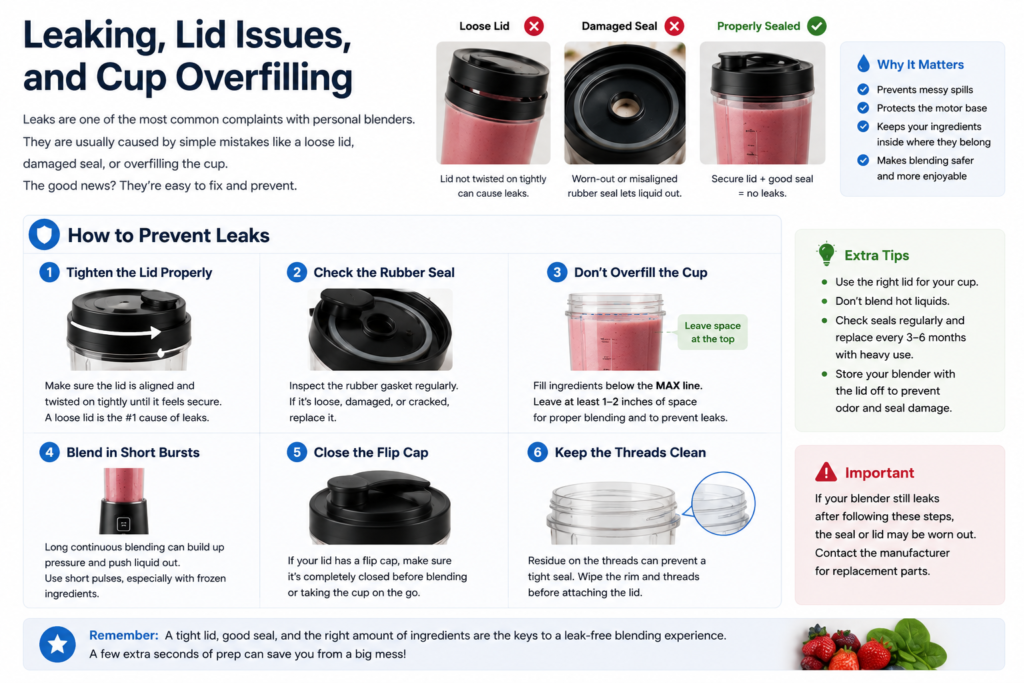
Leaking is one of the most frustrating personal blender problems, especially if you use your blender for smoothies, protein shakes, or drinks on the go. In most cases, leaks happen because the cup is overfilled, the lid is not tightened correctly, the seal is dirty, or ingredients are blocking the lid from closing properly.
Before assuming the blender is defective, check the basics first. Make sure the cup is below the max fill line, the lid is fully locked, the gasket or seal is clean, and the blade area is attached correctly. These small checks can prevent most leaking issues.
| Leak Problem | Possible Cause | How to Fix It |
|---|---|---|
| Liquid leaks from the lid | The lid is loose, tilted, or not fully locked | Remove the lid, wipe the rim, and twist or press it closed again. |
| Smoothie leaks during blending | The cup is overfilled or ingredients are above the max line | Remove some ingredients and leave space for liquid movement and foam. |
| Leak near the blade area | The seal or gasket may be dirty, loose, or worn | Clean the gasket area and check for cracks, stretching, or damage. |
| Foam pushes out of the cup | Too much liquid, protein powder, or carbonated liquid | Use less liquid, avoid carbonated drinks, and blend in shorter pulses. |
| Leaking after travel | The travel lid may not be fully secured | Check the lid before placing the cup in a bag, car holder, or backpack. |
How to Prevent Leaks
The best way to prevent leaks is to avoid overfilling the cup. Personal blenders need extra space for ingredients to move, foam to rise, and pressure to release safely. If you fill the cup all the way to the top, even a secure lid may leak during blending.
Always follow the max fill line on the cup. Add liquid first, then soft ingredients, then powders, greens, and frozen items last. This helps the mixture blend more evenly and reduces pressure around the lid.
You should also clean the lid, rim, gasket, and blade area after every use. Smoothie residue can dry around the seal and stop the lid from closing tightly. If the gasket looks cracked, loose, or stretched, it may need to be replaced.
Quick rule: keep the cup below the max line, clean the seal after each use, and never blend hot or carbonated liquids in a sealed personal blender cup.
Cleaning Mistakes That Cause Odor and Residue
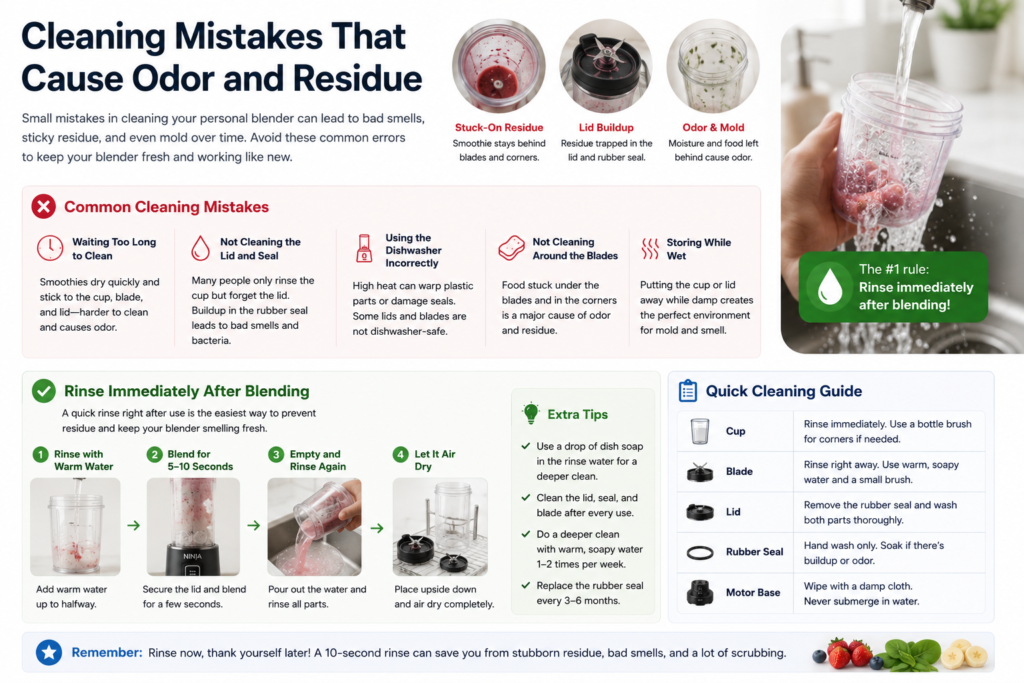
Some personal blender problems start after blending, not during blending. If your blender cup smells bad, feels sticky, or has residue around the lid or blade area, the most likely cause is delayed cleaning. Smoothie ingredients like protein powder, milk, yogurt, fruit, oats, and nut butter can dry quickly and leave buildup if they sit too long.
Odor and residue are especially common in personal blenders because the cups are small, the lids have tight seals, and smoothie ingredients can get trapped around the rim, gasket, drinking spout, or blade base. Even if the cup looks clean, hidden residue can still cause bad smells over time.
| Cleaning Mistake | What It Causes | How to Fix It |
|---|---|---|
| Waiting too long to rinse | Dried smoothie residue, sticky cup, bad smell | Rinse the cup, lid, and blade area immediately after blending. |
| Only rinsing the cup | Residue around the lid, seal, or drinking spout | Wash the lid and gasket area, not just the main cup. |
| Leaving parts wet after washing | Musty smell or moisture buildup | Let all parts air-dry fully before storing. |
| Ignoring protein powder buildup | Cloudy cup, lingering odor, sticky residue | Use warm water and dish soap right after protein shakes. |
| Storing the cup sealed | Trapped moisture and bad smells | Store the cup with the lid off until everything is completely dry. |
Rinse Immediately After Blending
The easiest way to prevent odor and residue is to rinse your personal blender right after use. Do not wait until smoothie residue dries inside the cup. Once ingredients dry around the lid, seal, or blade area, they become harder to remove and can create a sour smell.
For a quick clean, add warm water and a small drop of dish soap to the cup, then run a short blend cycle if your model allows it. After that, rinse the cup, lid, and any removable parts thoroughly. This works especially well after protein shakes, fruit smoothies, and drinks with yogurt or milk.
After washing, let every part dry fully before reassembling the blender. Storing a damp cup with the lid closed can trap moisture and create odor. If your personal blender still smells after washing, check the gasket, lid threads, drinking spout, and blade base for hidden buildup.
Quick rule: rinse right away, wash the lid carefully, and let everything dry before storing. This simple habit prevents many personal blender problems related to odor, residue, and long-term cleanliness.
Motor Overheating, Burning Smell, and Loud Noise
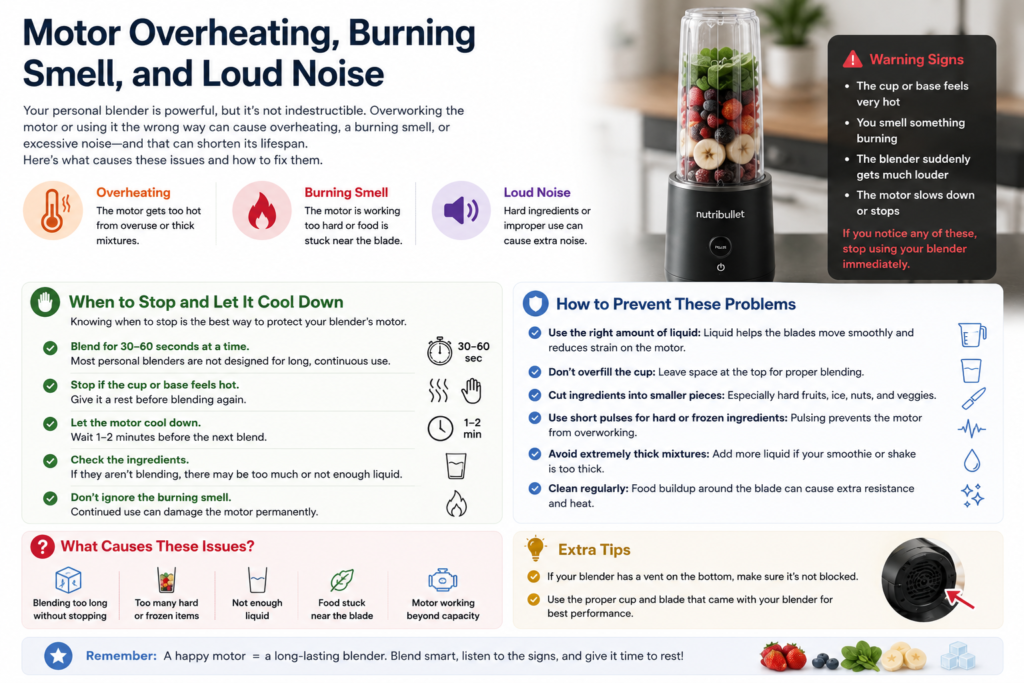
Motor overheating is one of the more serious personal blender problems because it usually means the blender is working harder than it should. A burning smell, very loud motor noise, slow blade movement, or sudden stopping can happen when the cup is overloaded, the mixture is too thick, or the blender runs too long without a break.
Personal blenders are designed for short blending cycles, not long continuous blending. If you force the motor through thick frozen fruit, ice, nut butter, oats, or very dense smoothie mixtures, the motor can heat up quickly and may start to smell hot.
| Warning Sign | Possible Cause | What to Do |
|---|---|---|
| Burning smell | Motor is overheating or mixture is too thick | Stop blending immediately, unplug if needed, and let the motor cool down. |
| Blades slow down or stop | Cup is overloaded or ingredients are stuck near the blade | Remove some ingredients, add liquid, and restart with short pulses. |
| Very loud noise | Hard frozen ingredients, ice, or unstable surface | Use smaller pieces, add liquid, and place the blender on a stable counter. |
| Motor feels hot | Blender has been running too long | Turn it off and let it rest before blending again. |
| Blender shuts off | Overload protection may have been triggered | Let it cool, reduce the load, and check the user manual before restarting. |
When to Stop and Let It Cool Down
You should stop using your personal blender immediately if you smell burning, hear a strained motor sound, or notice the blades struggling to move. Do not keep pressing the button if the ingredients are not blending. That can make the motor work harder and increase the risk of damage.
Turn the blender off, remove the cup if it is safe to do so, and let the motor rest. After it cools down, reduce the amount of ingredients, add more liquid, and blend in shorter pulses instead of one long cycle.
If the burning smell continues after cooling, do not keep using the blender.
Check the manual, inspect the blade area for stuck ingredients, and contact the manufacturer if the issue keeps happening. Repeated overheating can shorten the life of a personal blender.
Quick rule: if the blender smells hot, sounds strained, or stops moving smoothly, stop blending. Let it cool down, lighten the load, add liquid, and restart only when the motor is no longer hot.
Personal Blender Tips for Better Smoothies and Shakes
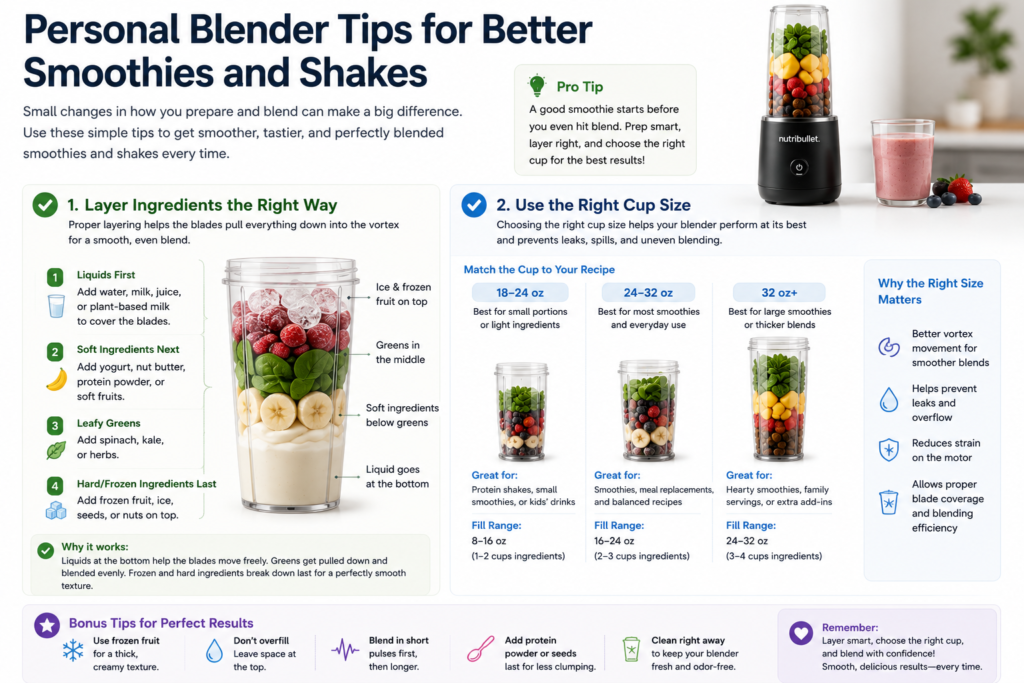
Many personal blender problems can be prevented before you press the blend button. If your smoothies come out chunky, too thick, foamy, or uneven, the problem may be your ingredient order, cup size, or liquid ratio rather than the blender itself.
For better smoothies and protein shakes, focus on three basics: layer ingredients correctly, leave enough room in the cup, and match the cup size to the drink you are making.
These small changes help the blades pull ingredients down more smoothly and reduce strain on the motor.
| Goal | Best Practice | Why It Works |
|---|---|---|
| Smoother smoothies | Add liquid first, then soft fruit, then greens, then frozen ingredients | This helps the blades create movement and pull ingredients down evenly. |
| Better protein shakes | Add liquid before protein powder | This reduces dry powder sticking to the cup or clumping near the blade. |
| Less motor strain | Use smaller frozen pieces and avoid overpacking the cup | Smaller ingredients are easier for the motor and blades to process. |
| Less leaking or foaming | Stay below the max fill line | Extra space lets ingredients move and reduces pressure inside the cup. |
| Better daily convenience | Choose the right cup size for your routine | A cup that is too small can overflow; a cup that is too large may be harder to carry. |
Layer Ingredients the Right Way
The best ingredient order for most personal blenders is simple: liquid first, soft ingredients second, powders and greens next, and frozen ingredients last. This order helps the blades start smoothly instead of fighting a dry or frozen block of ingredients.
For example, add water, milk, almond milk, oat milk, or juice first. Then add banana, yogurt, fresh fruit, protein powder, spinach, or greens. Finally, add frozen berries, frozen mango, ice, or other harder ingredients on top.
If your blender struggles, do not keep forcing it. Stop, add more liquid, shake the cup gently if your model allows it, and restart with short pulses. This can help prevent chunky texture, motor strain, and other common personal blender problems.
Use the Right Cup Size
Cup size matters more than many people think. A small cup is convenient for quick protein shakes, but it may not have enough room for frozen fruit, greens, oats, nut butter, and liquid. When the cup is too full, ingredients cannot move properly, which can cause uneven blending or leaking.
For simple shakes, a smaller cup can work well. For daily smoothies, a medium cup gives you more room for fruit, liquid, and protein powder. For thicker meal replacement shakes, a larger cup may be better because it gives ingredients enough space to circulate.
The key is to stay below the max fill line. Leaving space at the top helps reduce pressure, improves blending movement, and lowers the chance of leaks during use.
Quick rule: liquid first, frozen ingredients last, and never pack the cup to the top. This simple routine can prevent many personal blender problems and make your smoothies and shakes smoother every day.
still not fix your problem?? read our full personal blender guide
Frequently Asked Questions
Here are quick answers to the most common personal blender problems, including chunky smoothies, leaking cups, burning smells, ice blending, cleaning mistakes, and how to make your blender last longer.
Why is my personal blender not blending smoothly?
Your personal blender may not blend smoothly because there is not enough liquid, the frozen fruit pieces are too large, or the cup is packed too tightly. When ingredients cannot move freely around the blades, the smoothie may come out chunky or uneven.
To fix this, add liquid first, cut frozen ingredients into smaller pieces, and blend in short pulses before running a full cycle.
Why does my personal blender leak?
A personal blender usually leaks because the cup is overfilled, the lid is not tightened correctly, or the gasket is dirty, loose, or worn out. Smoothie residue around the rim can also stop the lid from sealing properly.
Stay below the max fill line, wipe the rim before closing the lid, and check the seal regularly. If the gasket is cracked or stretched, it may need to be replaced.
Can I put ice in a personal blender?
You can put ice in some personal blenders, but it depends on the model, motor power, and blade design. Stronger plug-in personal blenders usually handle ice better than compact cordless or low-power models.
For safer blending, use small ice cubes, add enough liquid, and avoid filling the cup with only ice. If the motor sounds strained, stop blending and reduce the load.
Why does my personal blender smell like burning?
A burning smell is one of the more serious personal blender problems. It usually means the motor is overheating, the mixture is too thick, or the blender has been running too long without a break.
Stop blending immediately, let the motor cool down, add more liquid, and restart with shorter pulses. If the burning smell continues, check the manual and stop using the blender until the issue is resolved.
How do I clean a personal blender after smoothies?
Rinse your personal blender immediately after blending. Add warm water and a small drop of dish soap to the cup, run a short blend cycle if your model allows it, then rinse the cup, lid, and blade area thoroughly.
Let all parts dry fully before storing. Do not store the cup sealed while it is still damp, because trapped moisture can cause odor and residue buildup.
Why does my smoothie come out chunky?
Your smoothie may come out chunky if you use too little liquid, large frozen fruit pieces, too much powder, or dense ingredients like oats, nut butter, or greens. Ingredient order also matters.
For smoother results, add liquid first, then soft fruit, then powders or greens, and frozen ingredients last. Use smaller frozen pieces and pulse before blending continuously.
How can I make a personal blender last longer?
To make a personal blender last longer, avoid overfilling the cup, do not force the motor through thick mixtures, and clean the cup, lid, and blade area after every use.
Use short blending cycles, let the motor cool if it feels hot, and follow the manufacturer’s instructions for ice, frozen fruit, and dishwasher-safe parts.
What should I not put in a personal blender?
You should not put hot liquids, carbonated drinks, large ice cubes, very hard frozen blocks, bones, dry grains, or extremely thick mixtures into a personal blender unless the manufacturer says it is safe.
Personal blenders are best for smoothies, protein shakes, soft fruit, greens, and properly sized frozen ingredients with enough liquid. Using the wrong ingredients can cause leaking, motor strain, blade damage, or overheating.
Final Thought
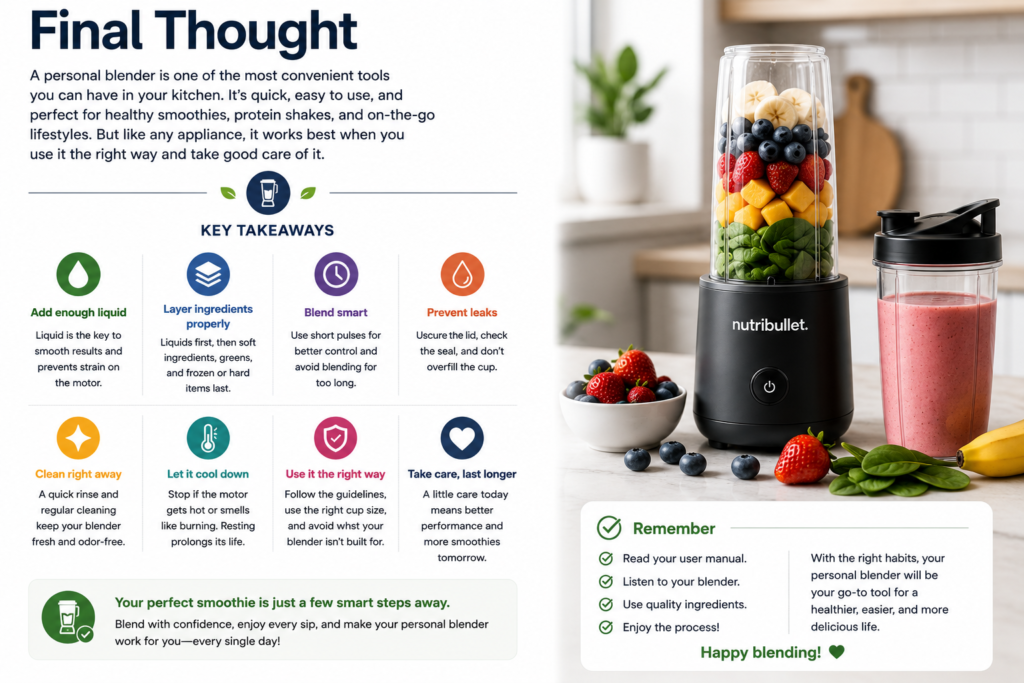
Most personal blender problems are easier to fix than they seem. Chunky smoothies, leaking cups, odor, burning smells, and loud noise are often caused by small habits like using too little liquid, overfilling the cup, adding ingredients in the wrong order, or waiting too long to clean the blender after use.
Before replacing your blender, start with the basics. Add enough liquid, cut frozen fruit into smaller pieces, stay below the max fill line, rinse the cup right after blending, and let the motor cool down if it starts to smell hot or sound strained.
A personal blender works best when you use it within its limits. Compact models are great for quick smoothies, protein shakes, and single-serve drinks, but they still need the right ingredient size, liquid ratio, and cleaning routine to perform well.
Final recommendation: if your blender is leaking, overheating, smelling bad, or not blending smoothly, check your cup filling, liquid amount, ingredient size, lid seal, and cleaning habits first. These simple fixes can solve many personal blender problems and help your blender last longer.