Table of Contents
Quick Comparison Table
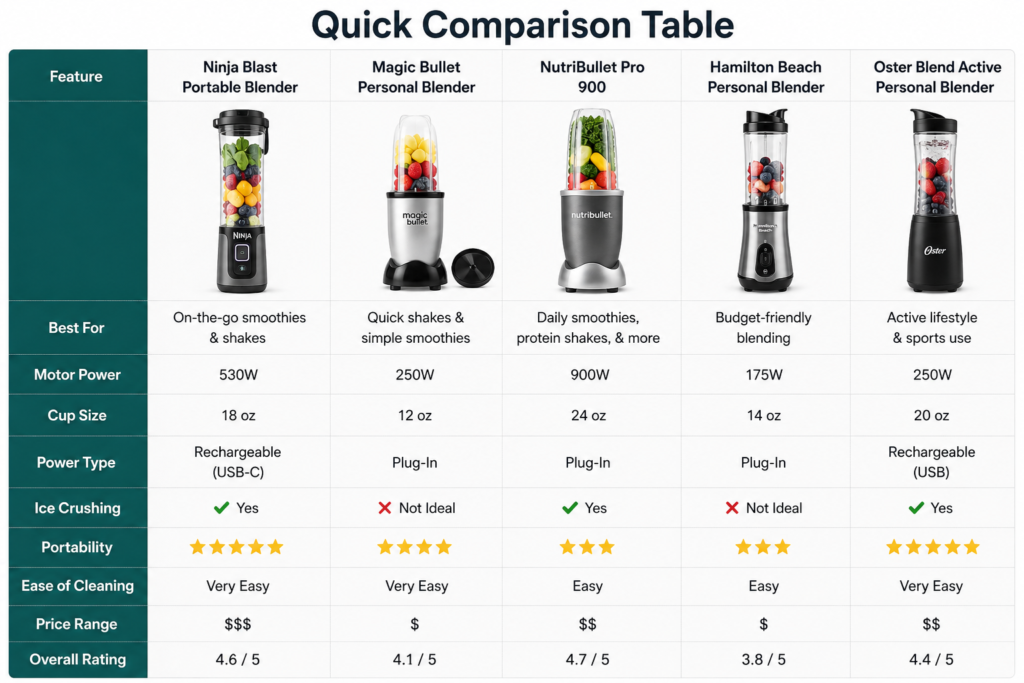
Before choosing a personal blender, think about how you will actually use it. A cordless blender is better for travel and small spaces, while a stronger plug-in model is usually better for frozen fruit, ice, and thicker smoothies.
This quick comparison table helps you narrow down the best personal blender based on your routine, budget, and blending needs.
| If You Need… | Look For… | Best Match From This List | Why It Fits |
|---|---|---|---|
| Travel, gym, office, or small spaces | Cordless design, removable vessel, leakproof lid | Ninja Blast Max Portable Blender | Best for users who want a portable personal blender they can use away from a kitchen outlet. |
| Daily smoothies and stronger blending | Higher motor power, larger cups, dishwasher-safe parts | NutriBullet Ultra Personal Blender | A strong pick for people who make smoothies, shakes, or nutrition drinks often. |
| Frozen drinks, ice, and thicker blends | High peak wattage, preset programs, strong blade system | Ninja BN401 Auto-iQ Personal Blender | Better for users who want more plug-in power and easier preset blending. |
| Simple smoothies on a budget | Lower price, basic controls, travel jars | Hamilton Beach Personal Blender | A practical choice for soft fruit smoothies, protein shakes, and beginner-friendly use. |
| Simple daily power without extra presets | Compact design, strong motor, easy twist-and-blend use | NutriBullet Pro 900 | A good fit for users who want straightforward smoothie blending with more power than basic models. |
If you are still unsure, start with your main use case. Choose the Ninja Blast Max if portability matters most, the NutriBullet Ultra if you want the strongest all-around smoothie option, the Ninja BN401 if you often blend ice or frozen ingredients, the Hamilton Beach if you want the lowest-cost option, and the NutriBullet Pro 900 if you want simple daily blending power.
Choose by Your Daily Blending Routine
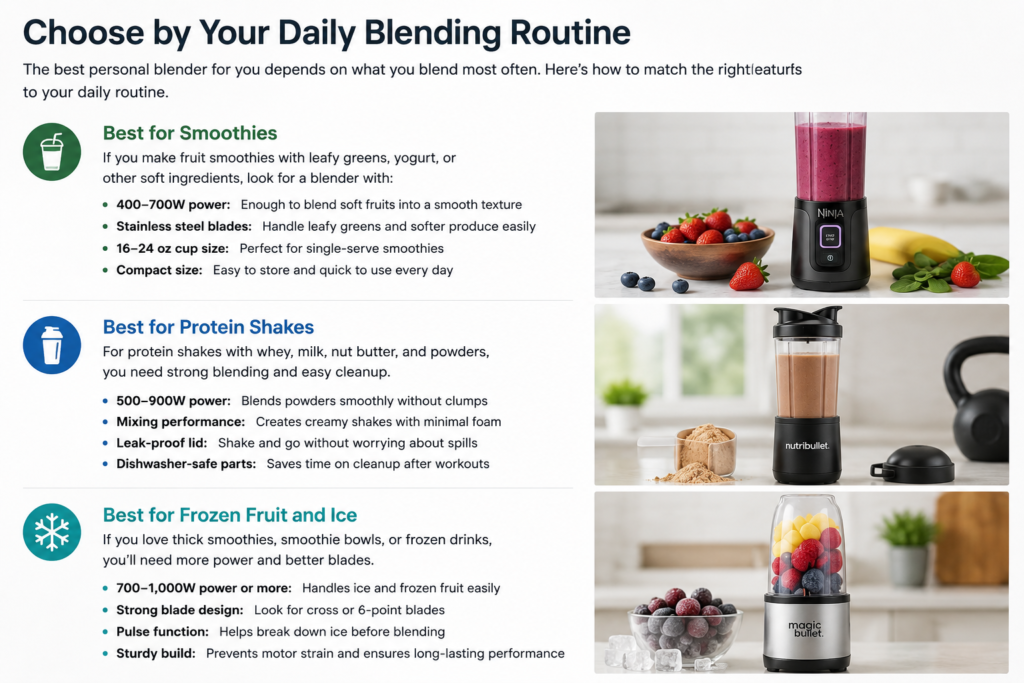
The best personal blender depends on what you make most often. If you only blend simple protein shakes, you do not need the same power as someone who blends frozen fruit, ice, and thick smoothies every morning.
Start with your daily routine first, then compare motor power, cup size, portability, and cleaning. This makes it easier to choose a personal blender that actually fits how you will use it, instead of paying for features you may not need.
Best for Smoothies
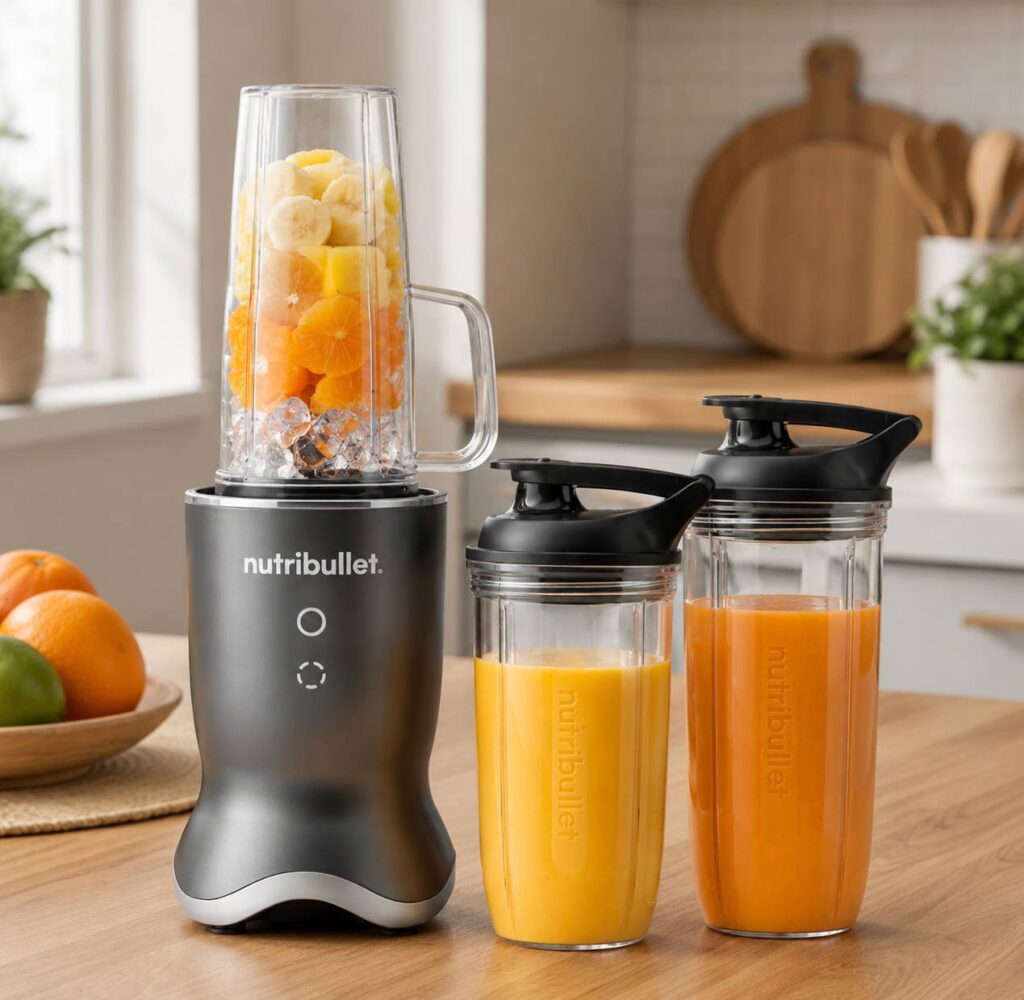
If your main goal is making smoothies, choose a personal blender with strong blending power, a practical cup size, and easy cleanup. The NutriBullet Ultra Personal Blender is a strong fit for daily smoothies because it offers higher power in a compact single-serve design.
This type of personal blender works well for fruit smoothies, green smoothies, and thicker drinks when you add enough liquid and avoid overfilling the cup. It is a better match for users who blend often and want smoother results than a basic budget model can usually provide.
Best for Protein Shakes
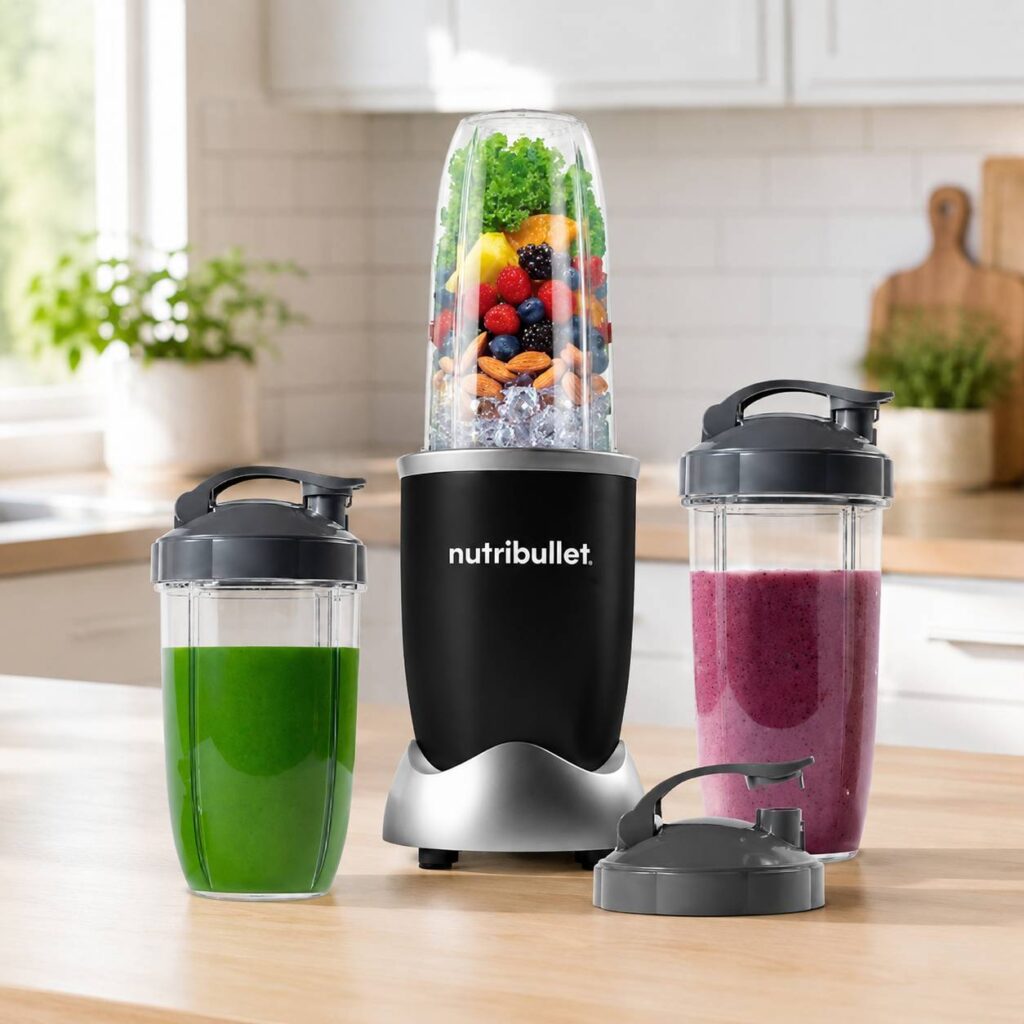
For protein shakes, you usually do not need the most powerful personal blender. A simple model that blends powder, milk, fruit, and ice smoothly is often enough. The NutriBullet Pro 900 is a practical choice because it offers strong everyday power without complicated controls.
If your routine is mostly post-workout shakes, breakfast drinks, or quick nutrition blends, focus on ease of use and cleaning. A personal blender that is fast to rinse and easy to drink from will be more useful than one with features you rarely use.
Best for Frozen Fruit and Ice
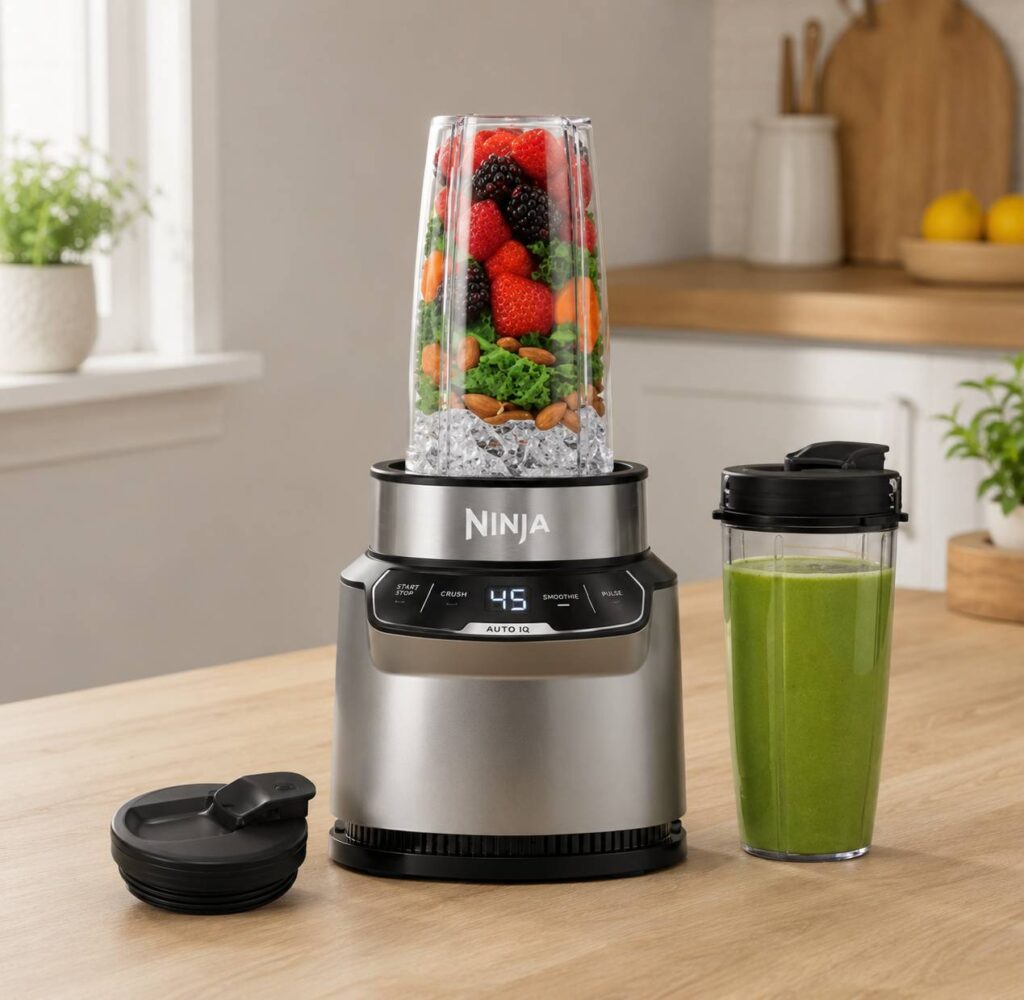
If you often blend frozen fruit, ice, or thick smoothie mixtures, choose a stronger plug-in personal blender. The Ninja BN401 Auto-iQ Personal Blender is a better fit for this use case because it is designed for smoothies, shakes, frozen drinks, salsa, and dips, with preset programs that make blending more consistent.
Portable and budget models can still work for lighter frozen drinks, but they may struggle with large ice cubes or very dense ingredients. For the best results, use smaller frozen pieces, add enough liquid, and choose a personal blender built for tougher blending tasks.
Motor Power and Blending Performance
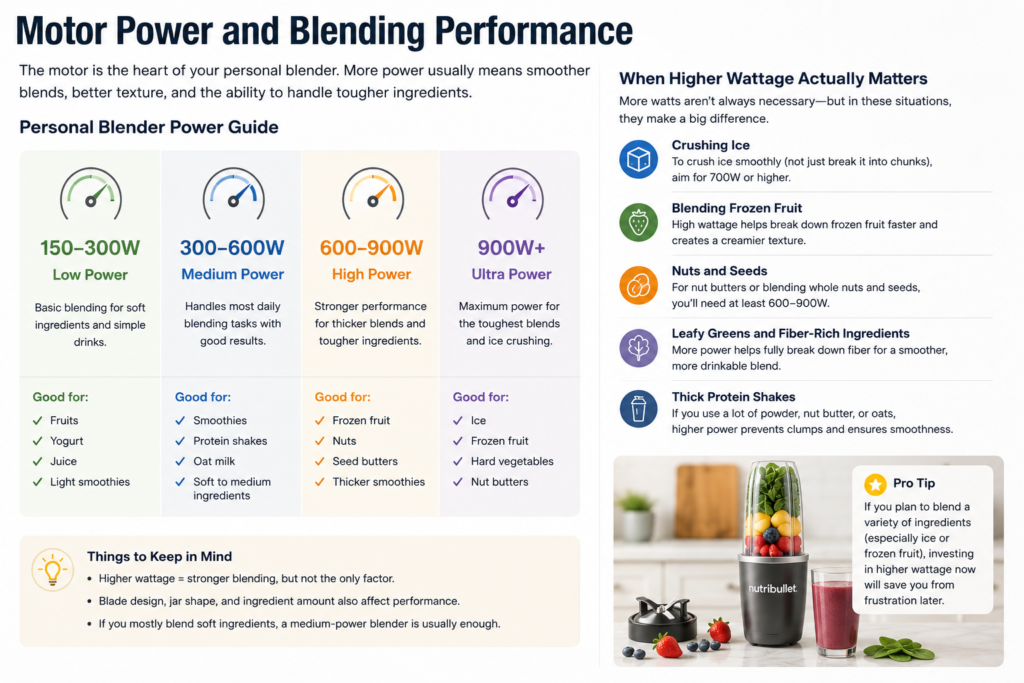
Motor power is one of the first specs people check when buying a personal blender, but wattage alone does not tell the full story. A higher-watt blender usually has more strength for frozen fruit, ice, greens, and thicker smoothie blends, while a lower-watt model can still be enough for soft fruit, protein powder, milk, and simple daily drinks.
For example, stronger plug-in models such as the NutriBullet Ultra and Ninja BN401 are better suited for users who blend frozen ingredients often. Simpler or lower-power models make more sense if your routine is mostly soft smoothies, protein shakes, or light blending.
| Power Range | Best For | What to Expect |
|---|---|---|
| Under 500 watts | Soft fruit, protein shakes, simple drinks | Good for basic blending, but may struggle with frozen fruit or ice. |
| 700–900 watts | Daily smoothies, greens, protein shakes | A good middle ground for most everyday personal blender users. |
| 1000+ watts | Frozen fruit, ice, thick smoothies, tougher blends | Better for smoother texture and more demanding ingredients. |
When Higher Wattage Actually Matters
Higher wattage matters most when you blend harder or denser ingredients. If you regularly use frozen berries, ice cubes, leafy greens, nut butters, or thick smoothie mixtures, a stronger personal blender can help create a smoother texture with less stopping and shaking.
However, higher wattage is not always necessary. If you mostly make protein shakes, banana smoothies, or simple fruit drinks, a basic personal blender may be enough. In that case, cup size, cleaning, portability, and lid design may matter more than raw power.
Motor Power and Blending Performance
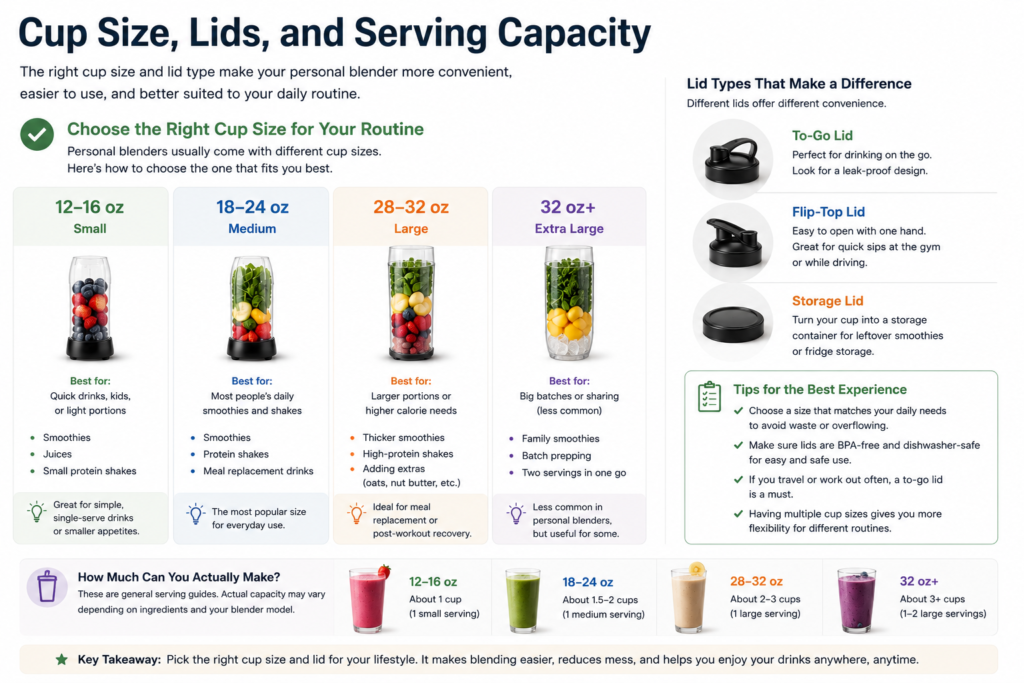
Motor power is one of the first specs people check when buying a personal blender, but wattage alone does not tell the full story. A higher-watt blender usually has more strength for frozen fruit, ice, greens, and thicker smoothie blends, while a lower-watt model can still be enough for soft fruit, protein powder, milk, and simple daily drinks.
For example, stronger plug-in models such as the NutriBullet Ultra and Ninja BN401 are better suited for users who blend frozen ingredients often. Simpler or lower-power models make more sense if your routine is mostly soft smoothies, protein shakes, or light blending.
| Power Range | Best For | What to Expect |
|---|---|---|
| Under 500 watts | Soft fruit, protein shakes, simple drinks | Good for basic blending, but may struggle with frozen fruit or ice. |
| 700–900 watts | Daily smoothies, greens, protein shakes | A good middle ground for most everyday personal blender users. |
| 1000+ watts | Frozen fruit, ice, thick smoothies, tougher blends | Better for smoother texture and more demanding ingredients. |
When Higher Wattage Actually Matters
Higher wattage matters most when you blend harder or denser ingredients. If you regularly use frozen berries, ice cubes, leafy greens, nut butters, or thick smoothie mixtures, a stronger personal blender can help create a smoother texture with less stopping and shaking.
However, higher wattage is not always necessary. If you mostly make protein shakes, banana smoothies, or simple fruit drinks, a basic personal blender may be enough. In that case, cup size, cleaning, portability, and lid design may matter more than raw power.
Cordless vs Plug-In Personal Blenders
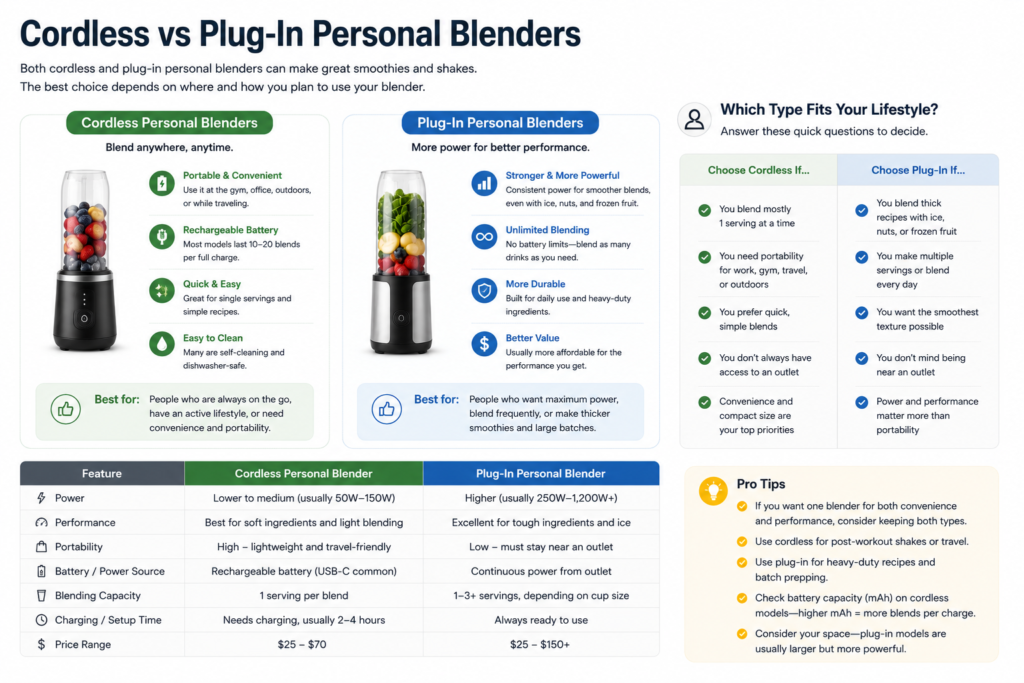
When choosing a personal blender, one of the biggest decisions is whether to buy a cordless model or a plug-in model. Cordless personal blenders are better for portability, small spaces, offices, gyms, and travel. Plug-in personal blenders are usually better for stronger blending, frozen fruit, ice, and thicker smoothies.
A cordless blender can be more convenient if you want to blend away from a kitchen outlet. For example, the Ninja Blast Max is built around portability, with a cordless design, a removable vessel, 3 blending programs, a leakproof lid, and dishwasher-safe parts. That makes it useful for people who care more about grab-and-go blending than maximum countertop power.
A plug-in personal blender is usually the better choice if you want more consistent power. Models like the Ninja BN401 use an 1100-peak-watt motor and Auto-iQ programs, while the NutriBullet Ultra includes a 1200-watt motor base and multiple cups. These types of blenders make more sense for users who often blend frozen fruit, ice, greens, or thicker drinks.
| Type | Best For | Main Strength | Possible Drawback |
|---|---|---|---|
| Cordless Personal Blender | Travel, office, gym, dorms, small kitchens | Portable, easy to move, no outlet needed during use | Usually less powerful than plug-in models |
| Plug-In Personal Blender | Frozen fruit, ice, daily smoothies, thicker blends | More stable power and stronger blending performance | Less portable and needs counter space near an outlet |
Which Type Fits Your Lifestyle?
Choose a cordless personal blender if your main priority is convenience. It is better for people who make quick smoothies at work, take drinks to the gym, live in a dorm, or need something compact for travel. If you mostly blend soft fruit, protein powder, and lighter drinks, cordless may be enough.
Choose a plug-in personal blender if your main priority is performance. It is better for people who blend frozen fruit, ice, leafy greens, oats, nut butters, or thicker smoothie mixtures. If you want smoother results and more consistent power, a plug-in model is usually the safer choice.
The simple rule: go cordless for portability, and go plug-in for power.?
Cleaning, Noise, and Daily Convenience
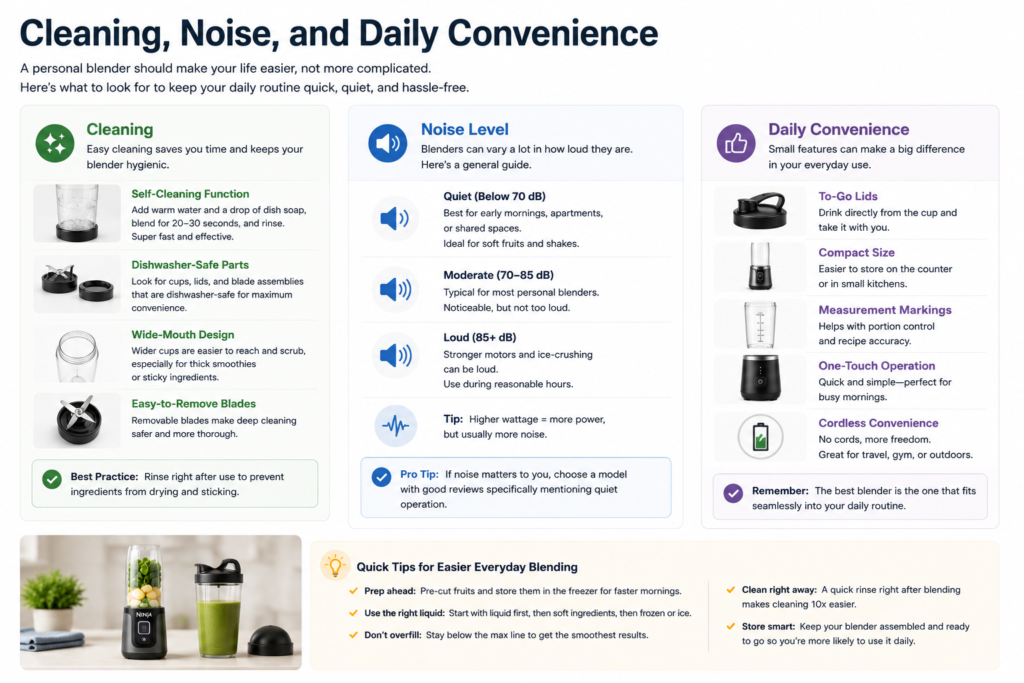
A personal blender should be easy to use every day, not just powerful on paper. Cleaning, noise level, lid design, and simple controls can make a big difference, especially if you plan to use the blender every morning or after workouts.
For cleaning, look for dishwasher-safe cups, lids, and removable parts when available. A blender that is hard to rinse can quickly become annoying, especially after thick smoothies, protein shakes, nut butter, or frozen fruit blends. The easier it is to clean, the more likely you are to use it consistently.
Noise is another factor to consider. Higher-powered plug-in models often blend tougher ingredients better, but they may also be louder. If you live in an apartment, have roommates, or blend early in the morning, check customer feedback for comments about noise before buying.
Daily convenience also comes down to small details: one-touch controls, preset programs, leak-resistant lids, travel cups, compact storage, and whether you can drink directly from the blending cup. These features may seem minor, but they can matter more than extra power if your routine is simple.
| Feature | Why It Matters | What to Look For |
|---|---|---|
| Easy Cleaning | Saves time after smoothies and protein shakes | Dishwasher-safe cups, simple lids, easy-rinse blade area |
| Noise Level | Important for apartments, roommates, and early mornings | Customer reviews mentioning quieter operation or acceptable noise |
| Daily Convenience | Makes the blender easier to use consistently | One-touch controls, presets, travel lids, compact storage |
| Leak Resistance | Useful for travel, gym bags, cars, and office use | Secure lids, removable vessel design, tight seals |
If two personal blenders have similar power, choose the one that is easier to clean and fits your daily routine better. A blender that feels convenient is usually the one you will actually use more often.
Common Mistakes When Choosing a Personal Blender
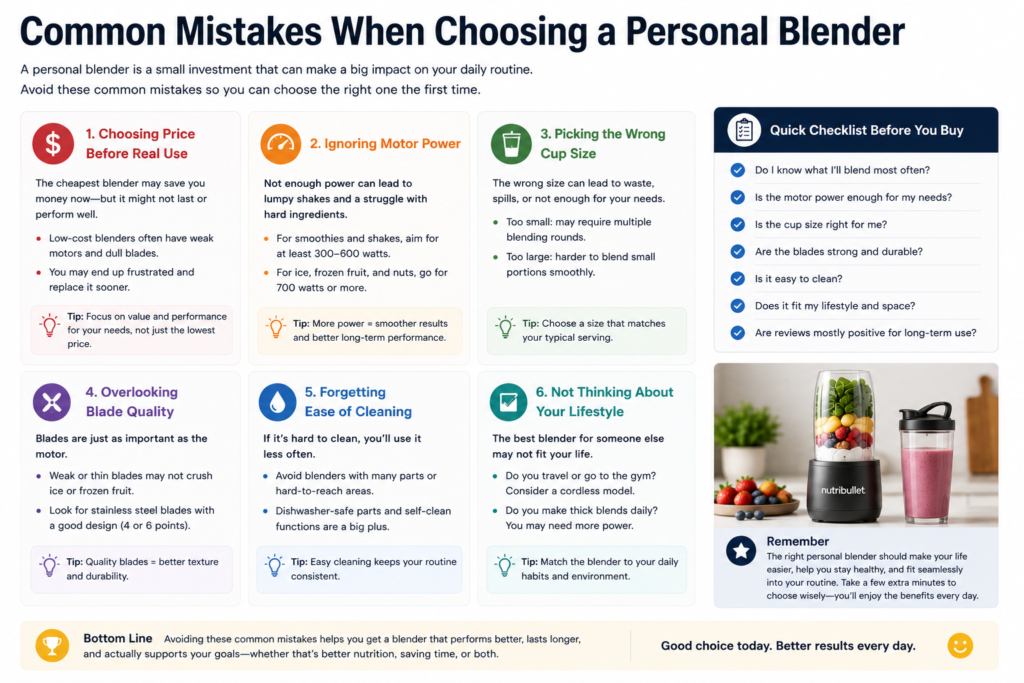
One of the biggest mistakes when choosing a personal blender is focusing on one feature too much. Price, wattage, cup size, or brand name can all matter, but none of them tells the full story by itself.
A good personal blender should match your actual routine. If you only make simple protein shakes, you may not need the most powerful model. If you blend frozen fruit, ice, greens, or thick smoothies every day, choosing the cheapest option may lead to weak blending, more shaking, and faster frustration.
| Common Mistake | Why It Can Be a Problem | Better Way to Choose |
|---|---|---|
| Buying only based on price | The cheapest blender may not handle your ingredients well. | Match the blender to your actual use case first. |
| Only looking at wattage | Power helps, but blade design, cup shape, and liquid amount also matter. | Compare performance features, not just motor numbers. |
| Ignoring cup size | A cup that is too small may not fit your smoothie routine. | Choose 14 oz for quick drinks, 22–24 oz for daily smoothies, and 32 oz for larger blends. |
| Choosing portability over power | Cordless models are convenient, but may not be ideal for tough frozen blends. | Choose cordless for travel and plug-in for stronger blending. |
| Forgetting about cleaning | A blender that is hard to clean may not get used often. | Look for dishwasher-safe cups, simple lids, and easy-rinse parts. |
Choosing Price Before Real Use
Price matters, but it should not be the first thing you use to choose a personal blender. A low-cost blender can be a good choice for soft fruit smoothies, protein shakes, and occasional use. But if you regularly blend frozen fruit, ice, oats, greens, or thick mixtures, a cheaper model may not give you the texture or consistency you want.
Before comparing prices, ask what you will actually make most often. A budget personal blender may be enough for simple drinks, while a stronger plug-in model may be worth the extra cost if you use it every day.
The better approach is to choose based on use first, then compare prices within that category. This helps you avoid overpaying for features you do not need, or buying a cheap blender that does not fit your routine.
Frequently Asked Questions
Here are answers to common questions people ask when choosing a personal blender. These FAQs can help you decide what size, power level, and blender type fits your daily routine.
How do I choose the best personal blender?
To choose the best personal blender, start with how you plan to use it. If you mostly make protein shakes or soft fruit smoothies, a simple compact model may be enough. If you blend frozen fruit, ice, greens, or thick smoothies often, choose a stronger plug-in model with higher power and durable blades.
You should also compare cup size, lid design, cleaning convenience, portability, and whether the blender fits your kitchen or travel routine.
How many watts should a personal blender have?
A personal blender should usually have at least 300–600 watts for basic smoothies, soft fruit, and protein shakes. For frozen fruit, ice, and thicker blends, look for a stronger model around 900 watts or higher.
Wattage is useful, but it is not the only factor. Blade design, cup shape, liquid amount, and ingredient size also affect blending performance.
Can a personal blender crush ice?
Some personal blenders can crush ice, especially higher-powered plug-in models. Lower-powered or cordless personal blenders may handle small ice pieces, but they are usually not the best choice for frequent ice crushing.
For better results, use smaller ice cubes, add enough liquid, and avoid overfilling the cup.
Can a personal blender blend frozen fruit?
Yes, many personal blenders can blend frozen fruit, but performance depends on motor power and blade design. Stronger models are better for frozen berries, mango, banana, and thick smoothie blends.
To get smoother results, use smaller frozen fruit pieces, add liquid first, and blend in short bursts if the mixture is too thick.
Is a cordless personal blender worth it?
A cordless personal blender is worth it if portability matters more than maximum power. It is useful for travel, offices, dorm rooms, gyms, small kitchens, and quick drinks away from an outlet.
If you mainly blend frozen fruit, ice, or thick smoothies at home, a plug-in personal blender is usually the better choice because it provides more consistent power.
What size personal blender cup is best?
The best personal blender cup size depends on your routine. A 14 oz cup is good for small drinks and quick protein shakes. A 22–24 oz cup is a practical size for most daily smoothies. A 32 oz cup is better for larger smoothies or meal replacement shakes.
If you plan to take your drink on the go, also check whether the cup includes a secure travel lid.
Are personal blenders easy to clean?
Most personal blenders are easy to clean because they use smaller cups and simple lids. Many models include dishwasher-safe cups or lids, which can save time after smoothies and protein shakes.
For best results, rinse the cup and blade area right after blending. This helps prevent dried residue, odors, and buildup around the seal.
Can a personal blender replace a full-size blender?
A personal blender can replace a full-size blender for single-serve smoothies, protein shakes, and simple daily drinks. It is more compact and usually easier to clean.
However, a full-size blender is still better for large batches, soups, sauces, nut butters, frozen desserts, and family-size servings. If you need more capacity and versatility, a full-size blender is the better long-term choice.
Final Thought
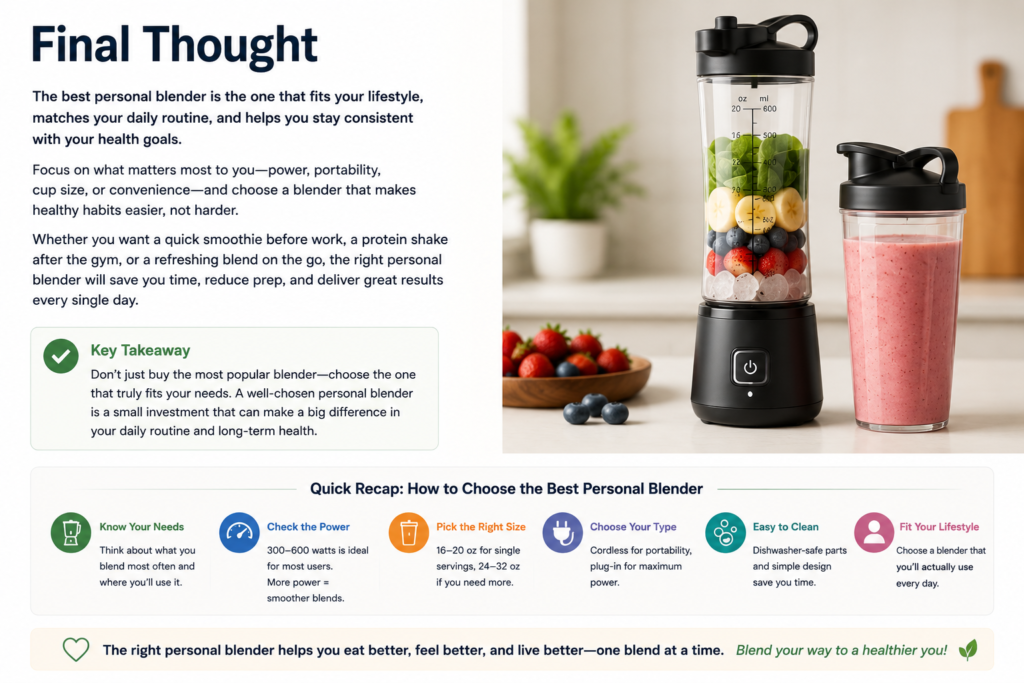
Choosing the best personal blender is not about picking the most expensive model or the highest wattage number. The better approach is to start with your real routine: what you blend, how often you use it, where you use it, and how much cleanup you are willing to do.
If you mostly make simple protein shakes or soft fruit smoothies, a compact and easy-to-clean personal blender may be enough. If you often blend frozen fruit, ice, greens, oats, or thicker smoothies, a stronger plug-in model is usually the smarter choice.
For travel, offices, gyms, dorm rooms, and small kitchens, portability and leak-resistant lids matter more. For daily kitchen use, motor power, cup size, blade design, and long-term convenience should matter more.
Final recommendation: choose a personal blender based on your daily use first, then compare price, power, cup size, and cleaning features. That will help you avoid overbuying, underbuying, or choosing a blender that looks good online but does not fit your routine.