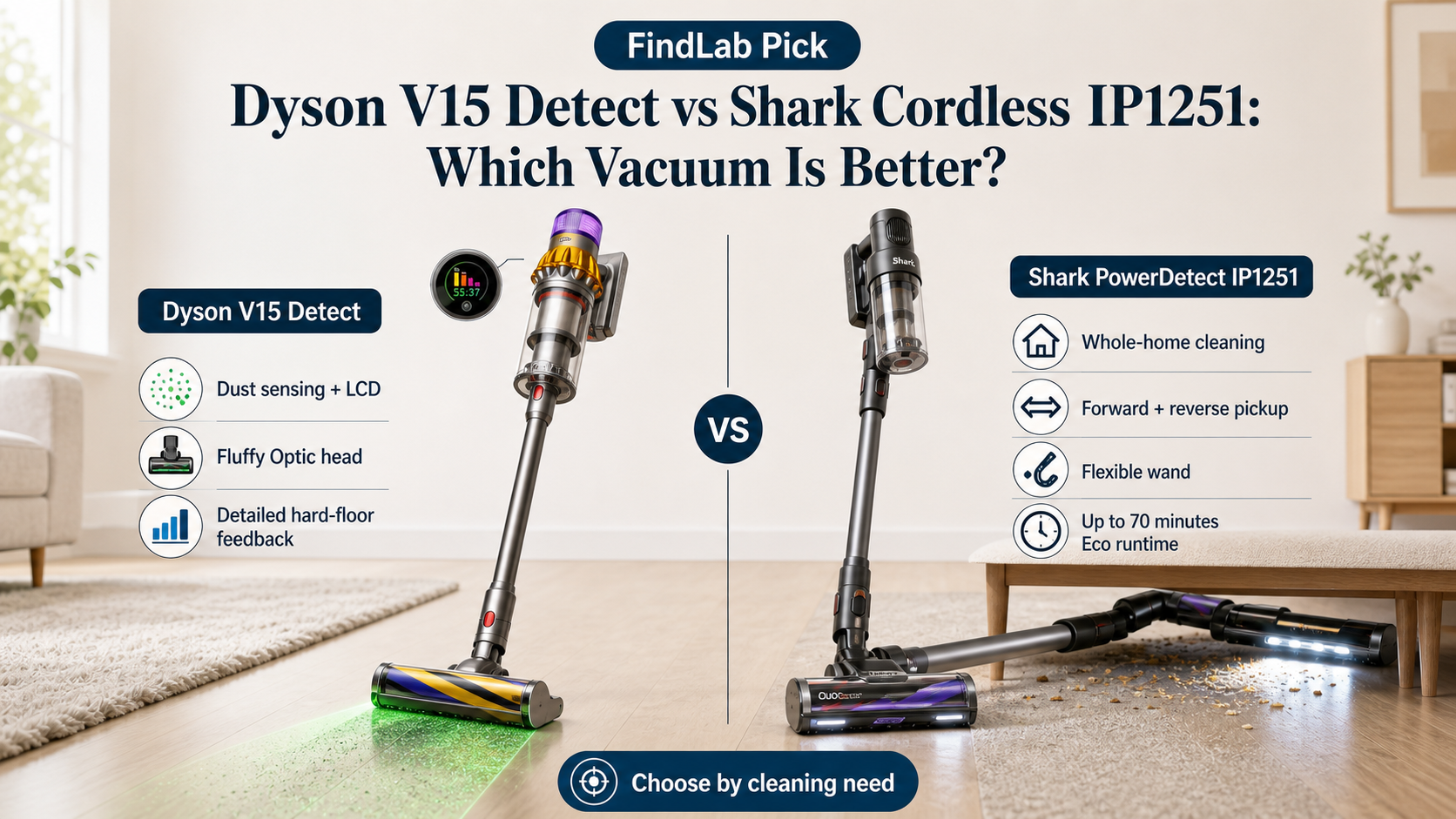
If you are choosing between the Dyson V15 Detect and the Shark PowerDetect IP1251, the main question is what kind of cleaning help you want every day.
The Dyson V15 Detect is built around strong suction, dust sensing, an LCD screen, and a Fluffy Optic head that lights up fine dust on hard floors. It is a better fit when you want more feedback while you clean.
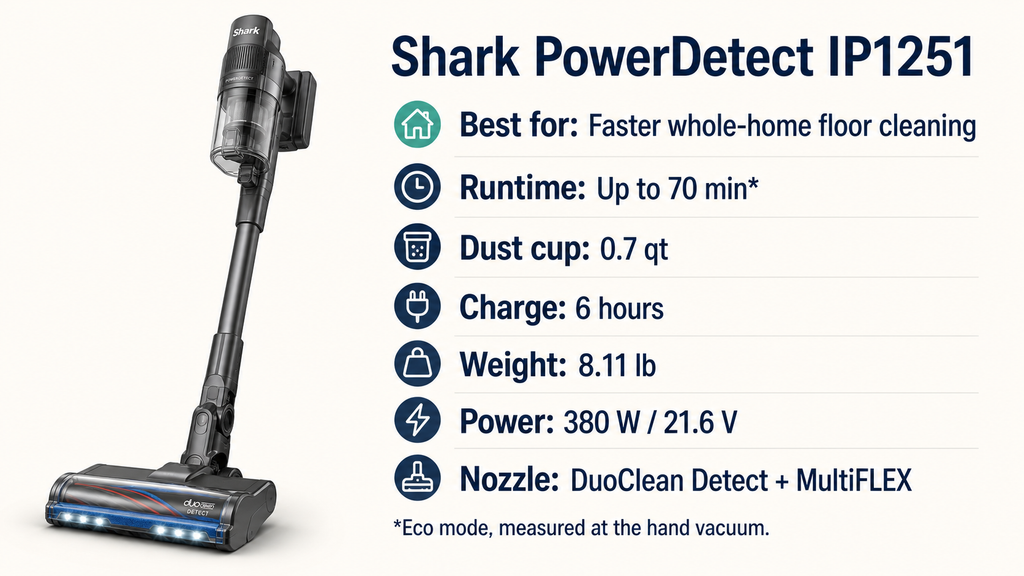
The Shark PowerDetect IP1251 focuses on faster whole-home cleaning. Its DuoClean Detect nozzle picks up debris in forward and reverse, its wand bends under furniture, and its listed Eco runtime reaches up to 70 minutes at the hand vacuum.
The biggest trade-off is feedback versus easier floor coverage. Dyson gives you more dust data and a more detailed hard-floor tool. Shark gives you a longer listed runtime, a flexible wand, and a 5-year warranty.
This comparison uses confirmed product details from Dyson and Shark product pages. It is not a hands-on, side-by-side test.
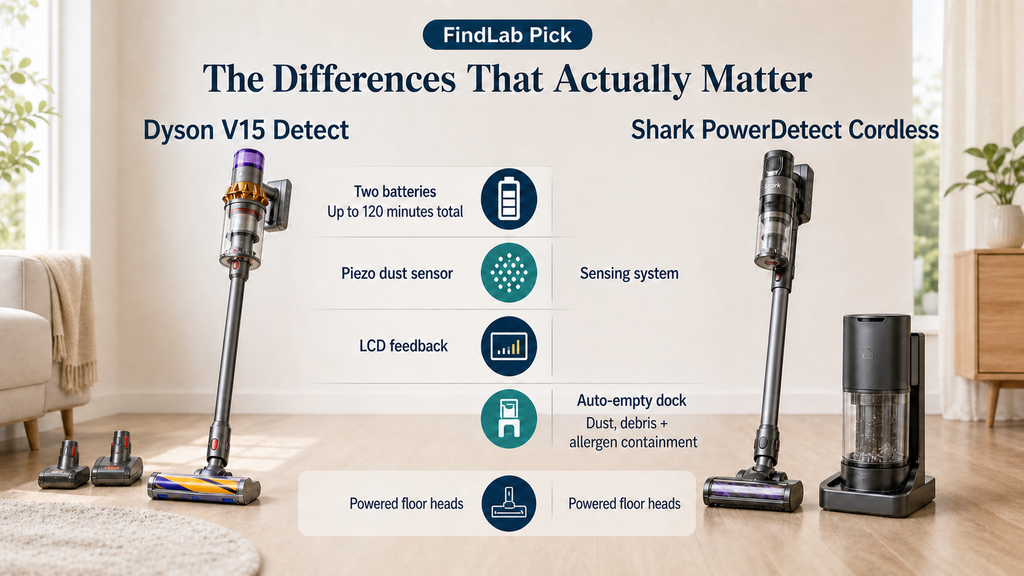
Dyson V15 Detect vs Shark Cordless IP1251 The Differences That Actually Matter
Dust Data vs. Dirt-Detect Cleaning
The Dyson V15 Detect uses a dust sensor to count and measure particles. Its LCD screen shows what the vacuum picks up, and Auto mode can change suction when the dust level changes. This is useful if you want clear feedback that a floor is getting cleaner.
The Shark PowerDetect IP1251 uses four detection systems for the floor, dirt, edges, and cleaning direction. It can increase power when it finds more dirt and is designed to pick up debris in both forward and reverse passes. It gives you more automatic cleaning help, but it does not show the same particle count screen.
Choose Dyson if dust feedback matters to you. Choose Shark if you want the vacuum to react while you cover the floor with fewer passes.
Fluffy Optic Dust Light vs. DuoClean Detect Nozzle
Dyson includes a Fluffy Optic cleaner head for hard floors and a Digital Motorbar for carpets and other floor types. The Fluffy Optic head shines light across the floor to reveal fine dust that is easy to miss.
Shark uses a DuoClean Detect nozzle with two brushrolls for different floor types. Its DirectionDetect feature is designed to collect more debris when you move backward as well as forward. The MultiFLEX wand also bends to help you reach under furniture.
Choose Dyson if you clean many hard floors and want to see hidden dust. Choose Shark if under-furniture reach and forward-and-back cleaning feel more useful.
60 Minutes vs. Up to 70 Minutes
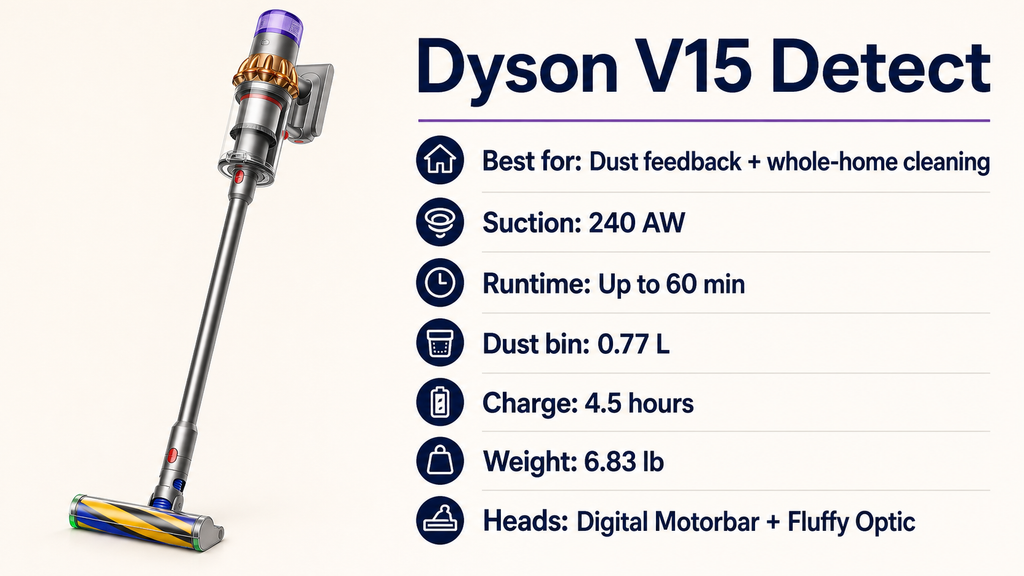
Dyson lists up to 60 minutes of runtime and a 4.5-hour charge time. That maximum depends on the power mode, floor, dust level, and tool. Its battery can be removed and replaced.
Shark lists up to 70 minutes in Eco mode when measured at the hand vacuum. Its product page lists a 6-hour charge time and one included battery. The longer number does not mean 70 minutes of the same cleaning power in every setup.
Choose Dyson if a shorter charge time or a replaceable battery matters more. Choose Shark if you want the longer listed Eco runtime for regular whole-home cleaning.
240 AW vs. 380 Watts: Read the Numbers Carefully
Dyson lists 240 air watts in Powerful mode. Air watts describe suction output, so this number is useful when comparing Dyson models.
Shark lists 380 watts and 21.6 volts for the IP1251, but it does not present that 380-watt number as air watts. Motor wattage and suction air watts are different measurements, so these two numbers should not be treated as a direct winner.
Choose based on the cleaning system, floor head, runtime, and daily handling instead of picking only the larger number. Dyson gives you a published air-watt figure and dust feedback. Shark gives you detection features, two brushrolls, and a flexible wand.
Key Spec Snapshot
Find Your Situation in 10 Seconds
Choose Dyson if dust feedback matters most
Pick Dyson when you want the LCD screen, particle sensing, and the Fluffy Optic head to show you fine dust on hard floors. You give up some listed runtime and pay more attention to the trigger-style control.
Choose Shark if easier floor coverage matters more
Pick Shark when you want a longer listed Eco runtime, forward-and-reverse pickup, and a wand that bends under furniture. You give up Dyson’s particle-count screen and published air-watt figure.
Shark PowerDetect IP1251
Best for: Flexible reach, reverse pickup, and longer Eco cleaning.
Check Shark price →Skip both if you need an auto-empty dock
Neither model in this comparison includes an auto-empty dock. Look for a clean-and-empty system if you want the vacuum to charge and empty its dust after every use.
What We Still Do Not Know
Neither brand gives us a fair, same-test comparison of cleaning performance between these exact versions. Dyson publishes 240 AW, while Shark publishes 380 watts. Those are different measurements, so the numbers cannot prove which one cleans better.
Runtime is not a direct apples-to-apples match either. Dyson’s 60-minute figure and Shark’s 70-minute figure depend on the mode, tool, and measurement setup.
Amazon prices, bundle contents, and availability can change. Check the current listing before buying, especially if you want a second battery, extra tools, or a clean-and-empty dock.